Monday, December 10, 2007

El Mirador

After leaving ARCAS on 19th Nov, I had a few fantastic (but expensive) days in Belize on the coast. More of that later when Hannah and I get there.....

By Sunday 25th, I was back in Flores and with one of my ARCAS compatriots, Jane, plus 3 other guys who all wanted to do the 5 day trip to El Mirador, or die trying!


Team Mirador: left to right, me, Jane, Peter, Rens, Tom, Garrett, Claude and Chato


To explain, El Mirador is one of the largest Mayan cities discovered, and has the largest temple, in the world, bar none. It is only very slightly excavated and restored, and is as close as you can come to walking through an undiscovered Mayan city lost in the jungle. It is also re-writing some Mayan history - it reached it's zenith during Pre-Classic times, and obtained a level of sophistication that was previously thought not to exist until the Classic era with cities like Palenque and Tikal.

The big thing about Mirador, however, is the getting there. It exists in the low-lying Mirador basin, 64km from the nearest dirt track. The paths there are well trodden by mules and people but nothing else, and for many kilometre long stretches these are nothing but mud - thick, cloying, suck-your-boot-off mud, or very deep, watery mud. Imagine 2 days walking in thing wellington boots, covering 30km-plus each day, mostly in mud, in 80-90Âș heat with a constant cloud of mosquitos and sand-flies awaiting just the briefest pause (and sometimes not even that), and you being to get the idea. It is hard, not just a bit but very, very hard.

Originally a team of 3 - myself, Jane and a Dutchman called Rens who was looking to go - we ended up with 4 others - Garrett and Peter who were recruited by Rens in PoptĂșn, plus Tom and Claude, a couple of guys who we didn't realise were even coming until the morning we left. On top of that there was our guide - Alex, 19 years old, very knowledgable and with a .357 Magnum stuck perpetually in his belt, plus our two muleteers, Daniel and Chato. That made 10 plus 5 pack mules and 2 for riding (one reserved for us gringos in case of emergencies of just exhaustion).


Camp at the first night


I'll just show you the photos. For me, day 2 was probably the worst - a neverending 33km of mud, slippery rock, thorn trees, mosquitos. And jungle... the most fabulous jungle.


Garrett and Daniel, very tired at lunch on day 2


The restoration workers at El Mirador (plus a few gringos)


The team on top of La Danta, the highest temple anywhere.


On top of La Danta, wearing my clean trousers.


Inside a Mayan tomb underneath a temple, day 4


Yours truly at the finish (and just about dead)


Back where we started - the team at the finish

Friday, December 07, 2007

And the monkeys.....

The last group of animals that are regularly received at ARCAS are, of course, monkeys. There are 2 species of monkey that are normally received - the Yucatan (or Guatemalan) Black Howler Monkey, and the Spider Monkey. Each year a handful of howlers are received, and perhaps 15-20 spider monkeys are received. The majority of these animals, as per usual, come from seizures made at border checkpoints; a few have been kept as pets and are no longer wanted.
In my time at ARCAS there were probably around 60 spider monkeys in various groups, plus 6 howler monkeys overall - although when I left there were just 3 left. The 2 species respond very differently to captivity, so I'll deal with the Howlers first.


Guatemalan Black Howler Monkey


In Guatemala, black howler monkeys are endangered - as they are in the parts of Mexico and Belize where they still exist. There are larger concentrations of black howler monkeys in South America but they are of a different sub-species. They usually live in family groups of 7-10 animals in the wild. Their name comes from the incredible, distinctive howling that serves as their territorial warning. They produce the highest decibel noise of any land mammal, easily audible several kilometres away through thick jungle.


The average life span of any black howler in captivity is three months: that's right, 3 whole months. They respond very poorly to the stress of captivity and suffer easily from diseases exacerbated by stress-related immunosupression. Since it's founding in 1989, ARCAS has singularly failed to release any single howler monkey into the wild, as all have died before reaching a rehabilitated stage. So far the most likely success story was in 1998, when a relatively happy group of 7 howlers were living together as a functioning troop. Then along came Hurricane Mitch, and a week of incessant rain brought on enough stress that 6 of the animals died due to related causes. The remaining animal died shortly afterwards due to the stress of being alone.


On my arrival at ARCAS there were 5 howlers in quarantine - 3 in a group (2 males and a female) that had been present for some time, and a pair of females by themselves (attempts to integrate them into one group had failed violently). Just a week after my arrival the female pari undid both the locks of their cages and escaped - never to be seen again. The hope is that they have left the near area - full of human habitation - and found other wild howlers to live with. The remaining three are still in quarantine, awaiting a decision on what to do with them from CONAP. Although theoretically they are too small to be released as a family group into the wild, given the experience with spider monkeys (see later) this could be an option. At the moment, one idea being mooted is to release them into the Education section of ARCAS where they will be least stressed.


One juvenile howler monkey arrived whilst I was at ARCAS. It had been captured a couple of months previously (this usually involves killing the mother), and was given up as it appear to be dying. And dying he surely was - 2 weeks after we took him on, he died of a variety of problems, including emaciation, possible kidney failure and likely hypothermia.


Spider Monkeys

As far as monkeys can be different, Spiders and Howlers are the opposite ends of the spectrum. Spider monkeys - not threatened in the wild - are one of nature's survivors, very adaptable, intelligent and resilient.

Since ARCAS began, there have been just 4 spider monkey releases, the most recent at the end of October with the biggest and most sophisticated rehab and release programme yet.


When juvenile monkeys arrive initially, they have to spend several weeks in individual quarantine to ensure they seem healthy. This is the most distressing part of the whole process - these are social, pack animals and being held in solitary confinement is not nice to see. Particularly young monkeys - up to the age of 12-15 months - need so tender love and care. Previous experience has shown that lack of contact and body warmth greatly decreases their survival rates. It is for this reason that you can see photos of me holding and feeding the baby - they take very well to their often-changing surrogate mums.

At about 15-18 months up to 3-4 years of age, the monkeys enter the juvenile monkey enclosure. At this stage, the pre-pubescent animals are a delight to behold and work with - friendly, curious, wanting to jump on you or snatch your broom. It makes being detatched - not talking to them, no playing, not allowing them to climb on you - very difficult. Group sizes tend to be 10-11 animals; when a group is large enough, another one is started.

Sexual maturity is reached at 3-4 years old (females first, males later) and this is when problems more usually start. Many monkeys kept as pets are no longer wanted when they reach this age, as they often become unpredictable and violent. Only ARCAS workers are alowed to enter cages with them; and as soon as space becomes available, they are moved to the Pre-Rehab enclosure(10x10x6m). Here they wait, in a larger enclosure with more environmental enrichment, until the large Rehab enclosure becomes free.

Upon leaving the quarantine pens and going to pre-Rehab, the physical and medical part of the rehab is done. What follows is the hardest part - behavioural rehabiliation. The hardest challenge is the development of a functioning troop; this is not sometinhg that can be engineered, but will or will not happen - the story of the recent release tells all. In the Rehab enclosure - 50m by 75m, complete with full sized trees and bounded by a wide treeless strip and electric fence - monkeys begin to behave something like they would in the wild, albeit in a much more limited area. They may spend up to 2-3 years in this enclosure before being ready to be released.

The recent release in October saw 2 groups go into the wild - one group of 7 from the Rehab enlcosure, and one group of 10 from the Pre-Rehab enclosure. The Rehab group had been there for 3 years, but did not have a strong social structure; the Pre-Rehab group had much less experience of living in trees but did have a strong troop structure - they were the first Spider monkeys in ARCAS history to breed in captivity. the objective of the dual release was to compare the importance of a long period in the Rehab enclosure with the importance of strong troop structure. In both groups of animals the dominant male and female were tagged with radio collars and all animals had their pale bellies dyed with identifying marks.


The previous 3 releases of Spiders from ARCAS had little follow-up information - the first 2 releases, in fact, had no follow up whatsoever. In the last release in 2002, a group of 2 males and 8 females were released on an island in a lake in a national park.In the summer that lake dried out and the group split up and went separate ways - the dominant male withthe young females and the juvenile male with the older females!

Spider monkeys, thanks to their adaptability, need to be released a long way from human habitation where they will quickly adapt to the lack of human presence (and feeding). If released close to humans, they will probably try to get food and end up dead or as a pet. The release this October was in Rio Azul National Park, probably the most remote region of Guatemala, where there are no roads (not even dirt ones!) for access, and incredibly few people.

After the release the groups have been followed solidly for 2 months, and will be followed intermittently for another 4. However, within a few days several things happened.

The Rehab group, with it's poor social structure, split up alomst immediately and began integrating with other monkey troops from surrounding areas. Three days later, the dominant female was seen in the company of another released female and a wild male, whilst the dominant male was seen with a 2 wild females.

The Pre-Rehab group fared better... for 24 hours. After being spotted the day after release as the original intact troop, the following day the radio collar of the dominant male was found amongst a pile of monkey hair, jaguar droppings and jaguar prints. The troop split up the same day and the dominant female later seen in the company of wild monkeys. It was theorised that the dominant male had slept too close to the ground as the Pre-Rehab perches were not that high - something we changed before puttting a new group in.


So what does that teach us? A survival rate of 60-70% amongst the released monkeys is hoped for as a "good" outcome; however, the rapid destruction of the social structres formed in captivity and apparently easy integration of monkeys into wild groups implies to me, at least, that perhaps too long is spent on trying to form group structures. There is importance to the social aspect seen at ARCAS - not least the ability to interact with other monkeys - and longer term survival studies should hopefully give an indication of the importance of the social/behavioural side of the rehab stage. It is clear, however, that rehabilitating any monkey is not easy and there will always be more to learn.


Monday, November 12, 2007

What we do best - and worst

Well, it's been over a month since my last post - apologies all - but lots seems to have happened and there's always so little time to get on a computer. So, whilst I am waiting for Hannah to arrive, I'll pick up where I left off with a perhaps overly in-depth look at rehab at ARCAS. Feel free just to look at the pictures......


Yucatan Black Howler Monkey


The rehabilitation of animals at ARCAS can be a very quick, or very lengthy, process - it depends on the species.

1) Reptiles


Juvenile crocs awaiting feeding, weighing and measuring
Reptiles tend to be the easiest kind of animals to rehabilitate. This is because they do not form attachments with humans and after the appropriate medical and physical care, they can be released. In terms of crocodiles, this means until they reach at least 1 metre in length; for turtles, a certain weight has to be reached. In the meantime, they are kept in cages with pools that are cleaned on a weekly basis, and are fed chicken. Nobody gets very close, especially to our big croc, which is 1.5m long (crocs start seeing humans are food once they reach 1.8m in size). We now have 10 baby crocodiles, all about 30cm in length, which are fed chicken twice a week depending on the weather (less sun = less feeding). Our large croc was removed from an area of Lago Peten Itza close to an upmarket hotel - at the moment we are awaiting permission to relocate it, possibly to the Mayan site at Yaxha.


Here's one we prepared earlier......

2) Birds
For the rehabilitation of birds, the physical and medical elements are the most important and difficult stages. Each year ARCAS receives 300-400 birds - the vast majority being parrots, with a few toucans and other birds, usually for illegal export to be kept as pets. They are usually very young (stolen from their nests at a few weeks of age), dehydrated and under-nourished. Of the slightly older birds that have started to grow flight feathers, these are often clipped. In reality, approximately 85% of parrots captured died before they reach maturity.
At ARCAS, juvenile birds are fed a blended mix of fruit, rice, beans and maize, 5 to 6 times per day when they are young. As they get older the frequency of feeds decreases and they are moved onto a solid food diet, usually of banana or orange, plus a rice/beans/maize mix. As they get older still, they receive a daily amount of wild berries from the jungle, so they become accustomed to what they should be eating. Once birds have a full set of flight feathers and are big enough, they are released into larger cages where the are able to use their wings properly and fly. Here they are still closely monitored for signs of illness, bullying or feather plucking.


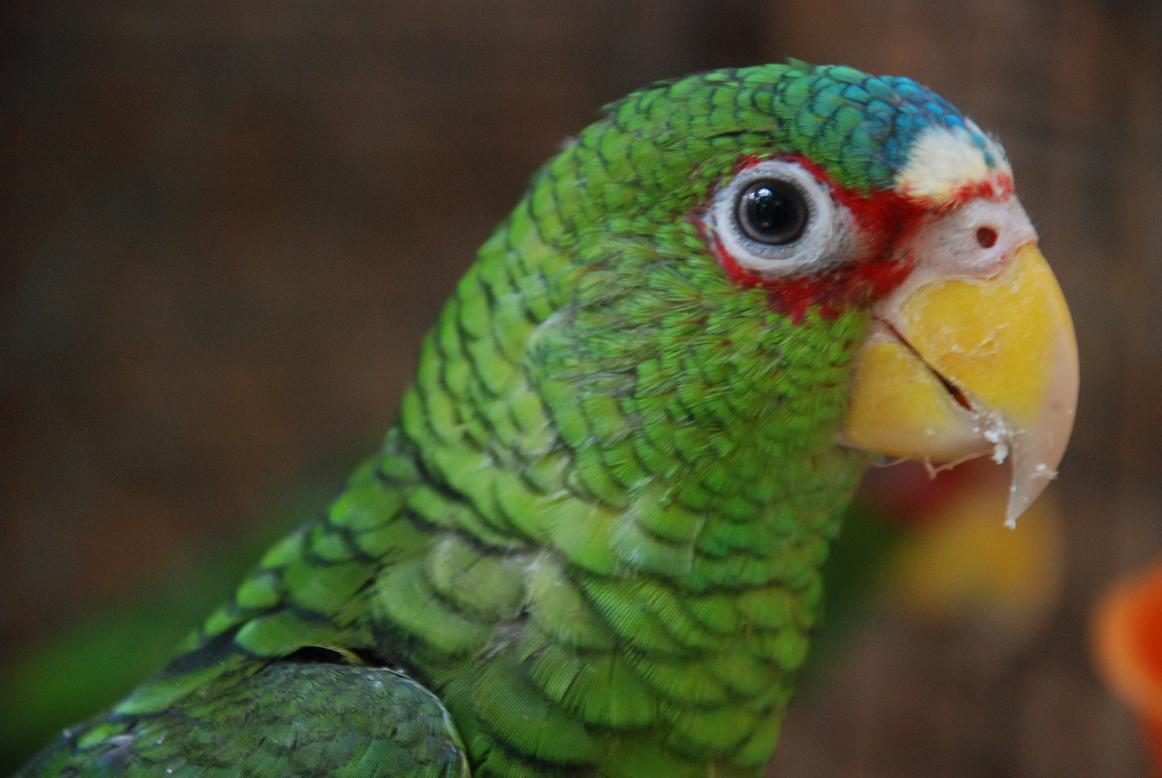
One of the several parrot species at ARCAS
Birds are then moved out of quarantine to a pre-rehabilitation cage where their contact with humans decreases, and their flying and perching ability increases. The pre-rehab cages are large and parrots may remain there for some time until permission is received from CONAP to release them into the wild. Then the birds are moved to a large 50m by 20 enclosure, 6m high, for a month. Here they have no human contact - they are fed once daily before it gets light - and quickly adapt to their surroundings. After 1 month they can be released, usually in a site distant from human habitation.
So what are the problems? Initially in quarantine birds have to overcome the stress of their capture and transport. Juvenile parrots tend to suffer from fungal infections because of the damp environment in the small quarantine cages (usually 50-100 cm per side); in the wild, they would tend to be high up in a sunnier, better ventilated canopy. Getting full sets of flight feathers is also a problem. If the bird arrives with clipped wings, they have to be at least 8 months old before these feathers can be removed - until that age there is a blood vessel inside the core of the feather. It then takes 3 months to regrow a set of flight feathers (after a series of vitamin A, D3 and E injections); if some feathers have been clipped then usually all the flight feathers need to be removed in stages a few weeks apart so a completely new set are grown. The other problem is that for several months at least birds are in regular contact with people, and so it is essential that when feeding and cleaning the birds you do not talk or interact with them - they are quick learners and birds that for strong bonds with people cannot be released.
Other birds at ARCAS include several keel-billed toucans - photos below - and scarlet macaws. There are only 180 breeding pair of scarlet macaws left in the wild in the Yucatan/Guatemala/ Belize area, although throughout the rest of Central and South America they are less threatened. ARCAS is a member of the "Guacamayas sin Fronteras" - Macaws without Borders - project that hopes to reintroduce rehabilitated birds into the wild, and also replace wild young that die with hand reared young that will be fostered by the parent birds. At the moment there are some 15 macaws awaiting reintroduction to the wild at ARCAS; the biggest problem is the need to get samples from wild birds to test for diseases that may be transferred to or from the wild birds. There is also a breeding programme of 4 pairs of macaws that this year have all successfully raised their young - although none were used as replacements in the wild due to lack of samples mentioned above.


Keel-billed toucan
3) Small Mammals
The small mammals at ARCAS vary in size, nature and diet. During my time there we had racoons, coatimundis, greater grisons, tayras, wild pigs and a kinkaju. All these animals are quite easy to rehabilitate physically and medically as they tend to be quite adaptable and eat almost anything. As with other ARCAS animals, most are caputured when being smuggled out of the Peten region for the international pet trade.
In the wild, racoons are ominvores and are fed as such at ARCAS - a mixture of bananas, rice, dog bisuits, chicken and eggs. Coatis get a fruit-based diet with some dog biscuits; in the wild their diet in fruit and insect based. Tayras and grisons, both part of the stoat/weasel family (but bigger) are also omnivores, and have a similar diet to the racoons. Kinkajus are noctural, tree dwelling (and very cute), who eat mainly fruit but really love dog biscuits.
The wild pigs were of 2 species - white lipped and white collared peccary - that during my time there had some problems. The white collared peccaries - the first to be cared for at ARCAS - both died within 2 weeks of each other of unexplained causes. Based on clincial signs and gross post mortem results we were suspicious of neurotoxins possibly from food (or a fungal toxin) or an infectious disease. At the time or writing, the hand-reared white lipped peccary also had 2 episodes of similar signs but had not died - the cause remains a mystery.
Although the small mammals tend to be easy to rear (with the exception of pigs!), they form human attachments very easily and are difficult to release in the wild unless far, far from humans. Because there are only a few to be released at a time and they are not threatened in the wild, expensive expeditions to far-off national parks cannot be justified. So instead, most small mammals are released at a private reserve, close to Flores, that has just 1000 acres of primary rainforest. Here there are no humans (except the odd tourist bus), which makes it an ideal habitat for the animals released there. In October we released 3 racoons, 3 coatis and 8 guans at the Park nears Flores. Our kinkaju remains in captivity, recently joined by another 2 (they live in groups of 7-15 in the wild) and hopeful for release in a few months.
At ARCAS there are also a number of white tailed deer - not exactly a small mammal, I know - kept for a breeding programme and planned re-introduction into the wild.
4) Felines


The hand-reared ocelot
There are 4 types of cat at ARCAS, ranging from almost domestic cat sized to really quite big! Of the two smaller species we have a jaguarundi and six margays; of the larger, there are 3 ocelots and one friendly, slightly overweight, jaguar.
Of the cats, only the 2 smaller species ever stand a real chance of being released. Both margays and jaguarundis need a small range to live in (several square kilometres), which make it possible for them to be released on private reserves like the small mammals.

Cum-chu, the ARCAS jaguar, not at her friendliest
Unfortunately, habitat pressures mean that ocelots and jaguars stand little chance of being released in the near future. Jaguars have a normal range of up to 100 square kilometres, and in the current circumstances across the Mexico/Guatemala/Belize region, there are too many problems with wild jaguars that need to be dealt with before release of rehabilitated animals can be considered. Principal pressures in the wild are the conflict between conservation of forested areas and farming, and jaguars killing farming stock. At the moment, studies are under way to tag several jaguars with GPS collars that can track their true range, especially in correlation with farm animal kills, in the hope that an accurate picture of the damage they may, or may not be inflciting becomes apparent. At ARCAS, 2 ocelots have been in captivity too long to allow their release into the wild; the third has been hand reared and this also makes it very unlikely that she can be released. The jaguar, Cum-chu, was found as a baby and hand reared; even without the problems existing for her release into the wild, ARCAS has neither the money or the space to train an adult jaguar to hunt and fend for herself.