Senggigi, on the western coast of Lombok, is a tourist town suffering from an oversupply of hotels and undersupply of tourists. Arrival there was greeted with a departure from the traditional "Hello mister!", and instead there was a distinctly Australian "G'day mate!" Offers of "Transport?" and "You need room?" came thick and fast, and before long I was settled in a beautiful hotel and sorting out my next trip - Rinjani.
Mount Rinjani is a 3700m volcano on northern Lombok - it dominates the northern half of the island and in the past few months has become increasingly active, resulting in the curtailment of normal trekking activities to the top in a 4 day jaunt. The Rinjani trek now consists of a trip to the crater rim - no mean feat in itself - and staying overnight, overlooking the small volcano of Gunung baru in the centre of the huge crater that is mostly filled by a large lake. In the past it was possible to go to the lake and swim in the hot springs, sadly this is no longer on the menu either.
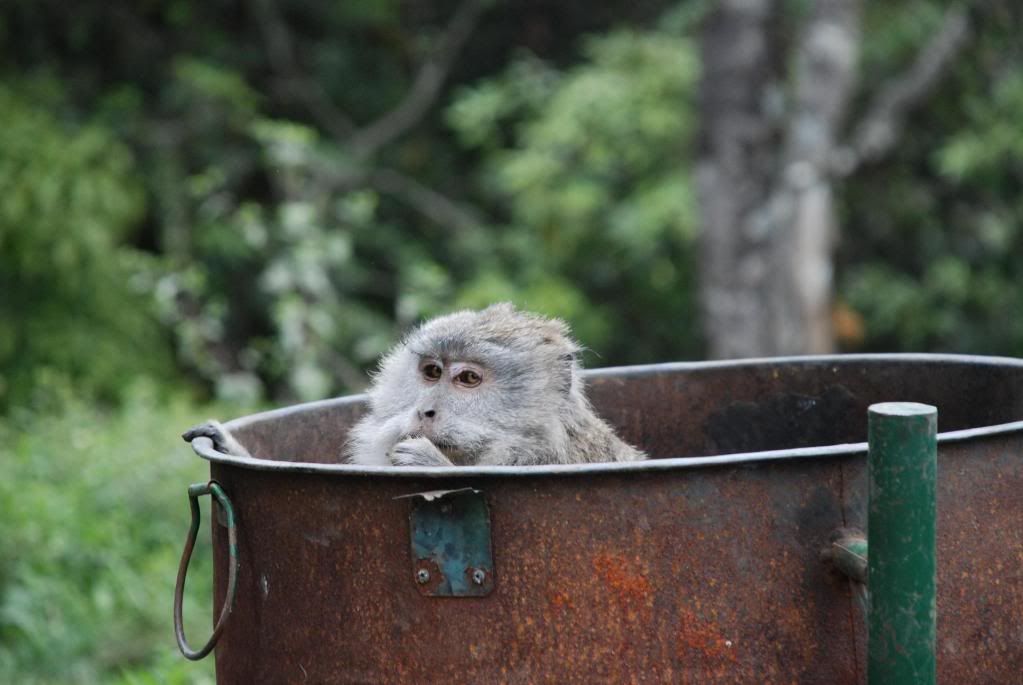
Monkey in a bin.... Rinjani
After a dinner with Francisco and Michela from the boat - we were to meet again in a few days - I turned in early for my early start the next day. After a very windy 2 hour car journey, by 7.30am I was on the trail with Sean and Justina, a nice American couple, plus our superhuman guides and porters who were happily walking up in flip flops with huge loads on bamboo poles over their shoulders.
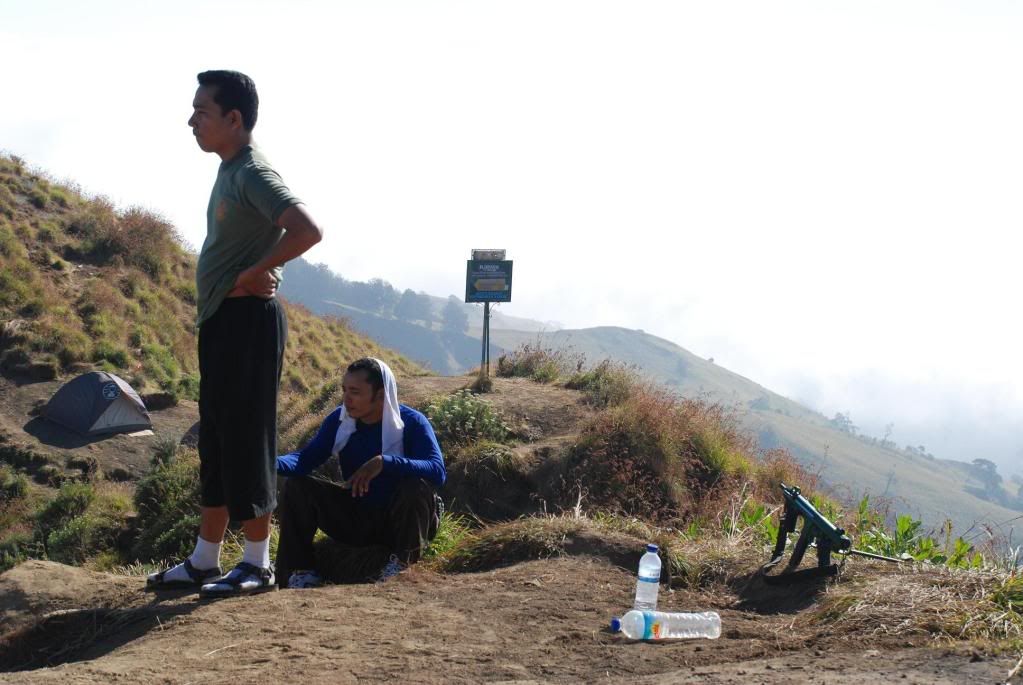
Within a couple of hours it was very, very warm and we were all drenched in sweat. The climb went on, ever uphill - the total height gain was some 2000m. There was an early lunch at 11.30am before we reached the crater rim in quick time - by about 2.30pm. Then it was a case of relaxing, watching, and trying not to get cold. Since the volcano increased its activity a few months ago and the lake and summit were closed, rangers have camped out at the crater rim to stop tourists venturing too far. We had met some climbing up, and they were very friendly despite being armed with machine guns to deter those really persistent travelers.
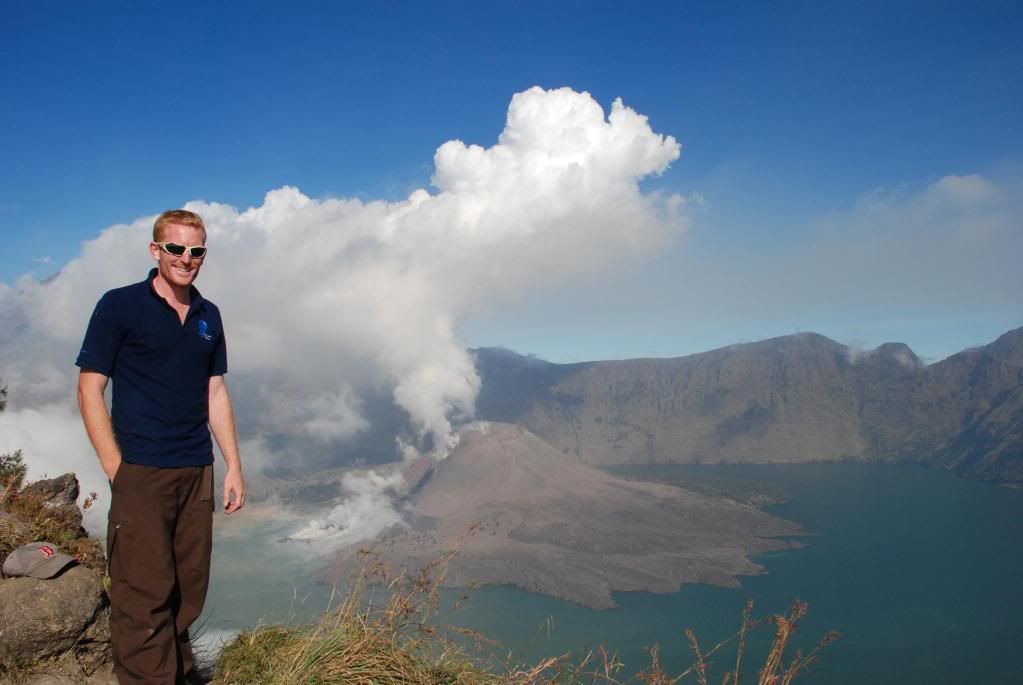
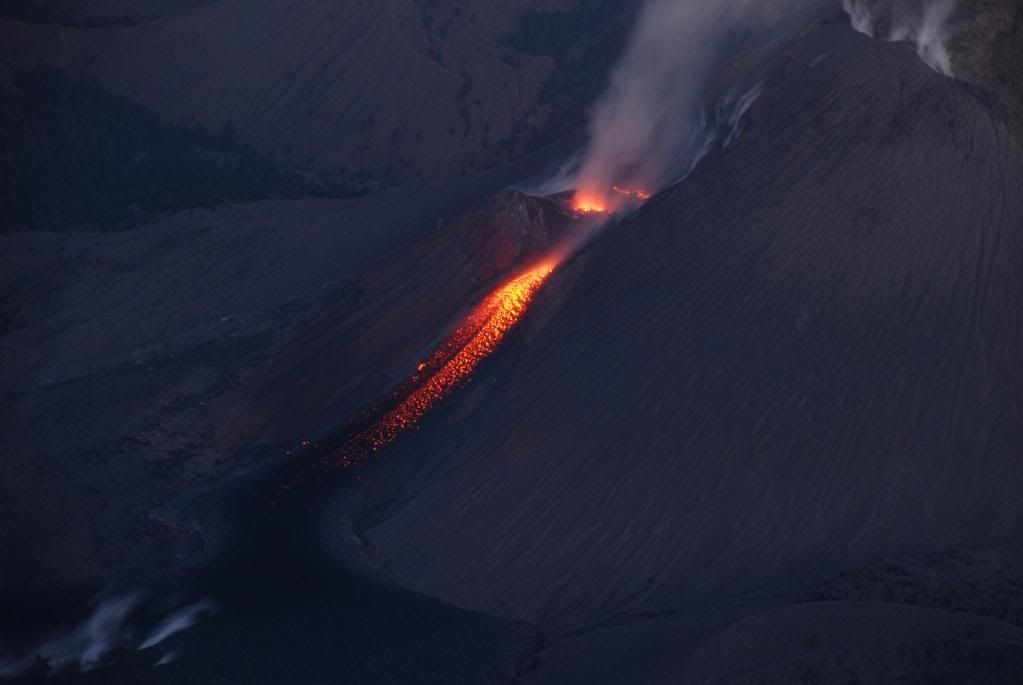
Gunung Baru, the small active central volcano, sounded almost like waves breaking as it gave out regular belches of steam and, as we were to see later, rocks and ash. As the afternoon pressed on the clouds cleared and we were treated to a stunning view over the whole crater, although below us the rest of Lombok was covered in cloud.
As the sun set the night grew colder but the views got better. Overhead was a cloudless, starry sky, whilst in the crater the glowing lava of Gunung Baru was an impressive sight. We turned in early again to the small forest of tents perched on the crater rim, tired and cold but full of excellent nasi goreng (fried rice) and plentiful tea.
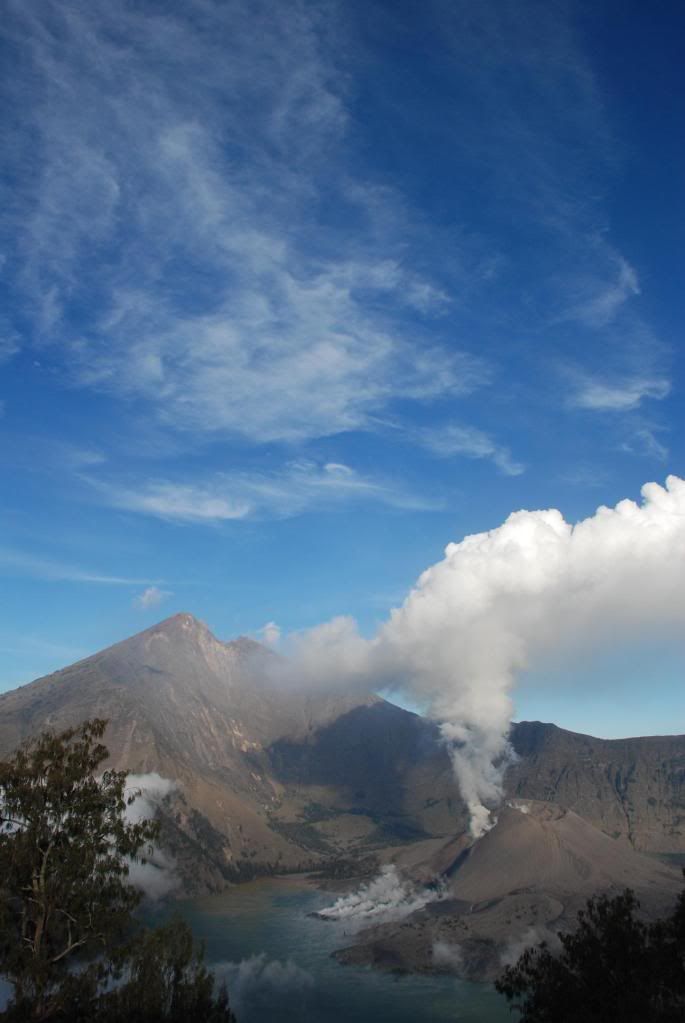
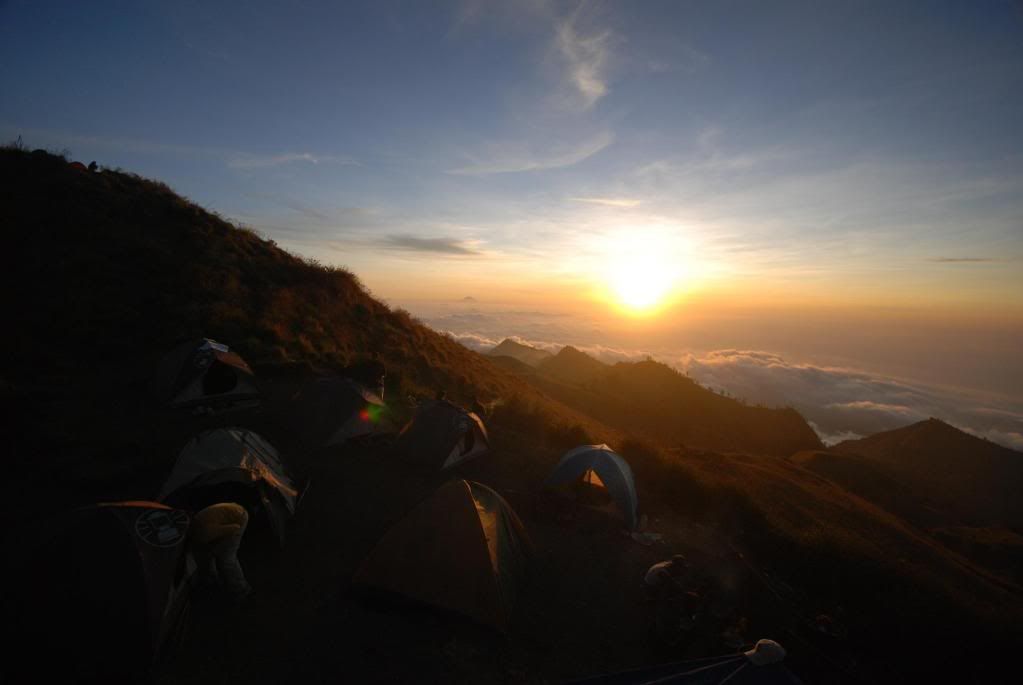
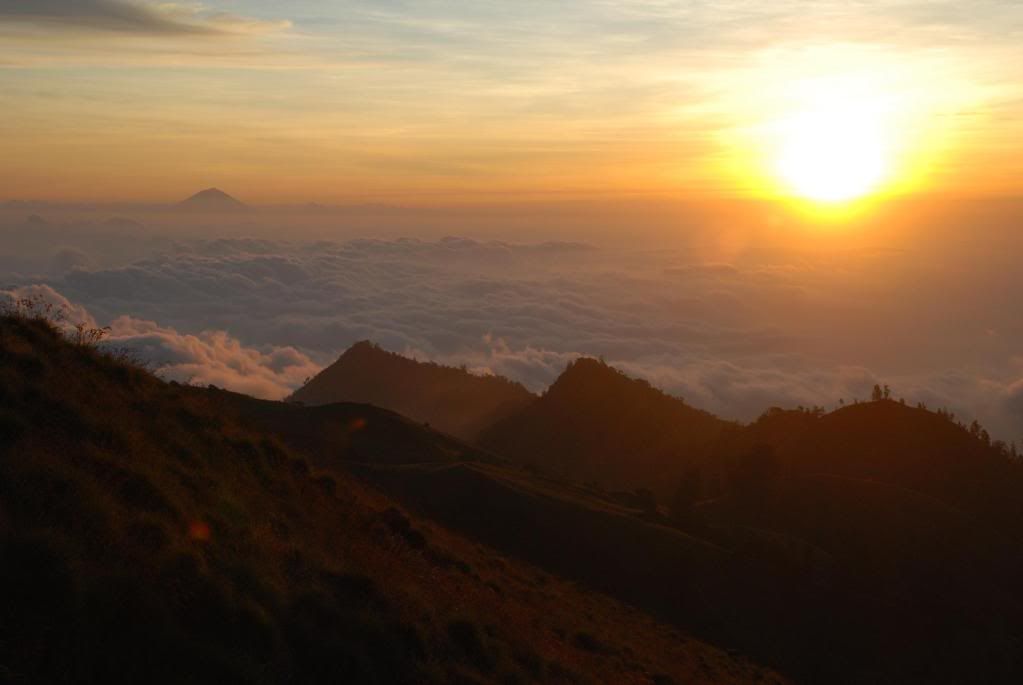
Sunset from Rinjani - Gunung Agung volcano, Bali, in the background
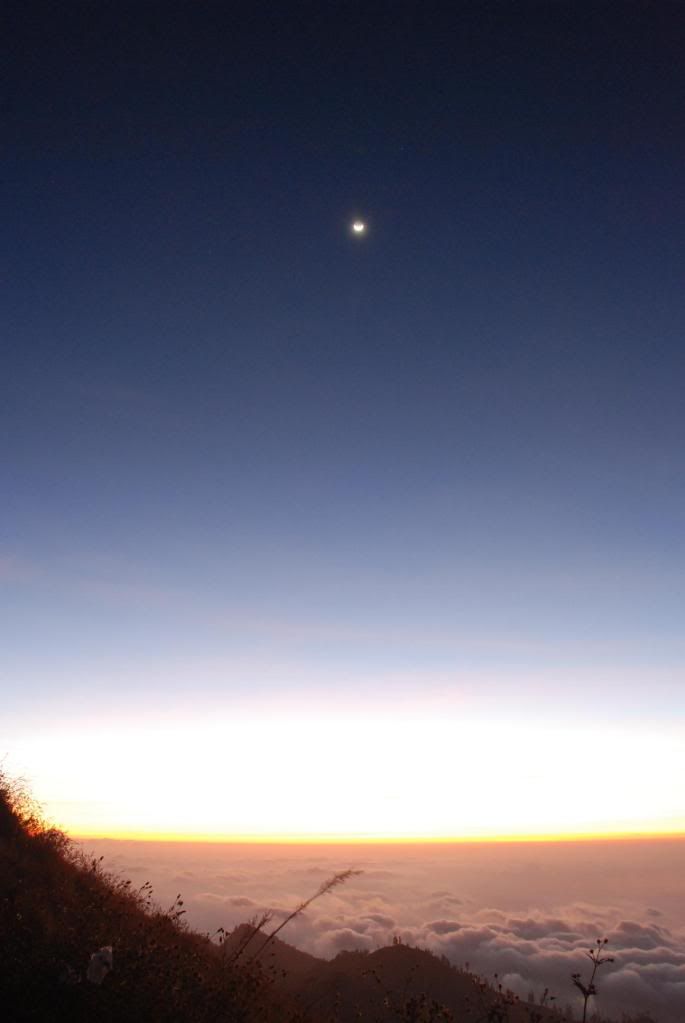
The following morning I was up for a disappointing sunrise - mostly obscured by the peak of Rinjani and the gases form the volcano - and we headed off back down the mountain after breakfast. In a moment of supreme fallacy I decided to try and race our guide down the steepest, slipperiest part of the volcano - it felt good at the time but I regretted it for about the next 4 days to come. Back in Senggigi a few hours later I had time for some laundry, more offers of transport and some rest, before I headed over to Gili Trewengan the next day.
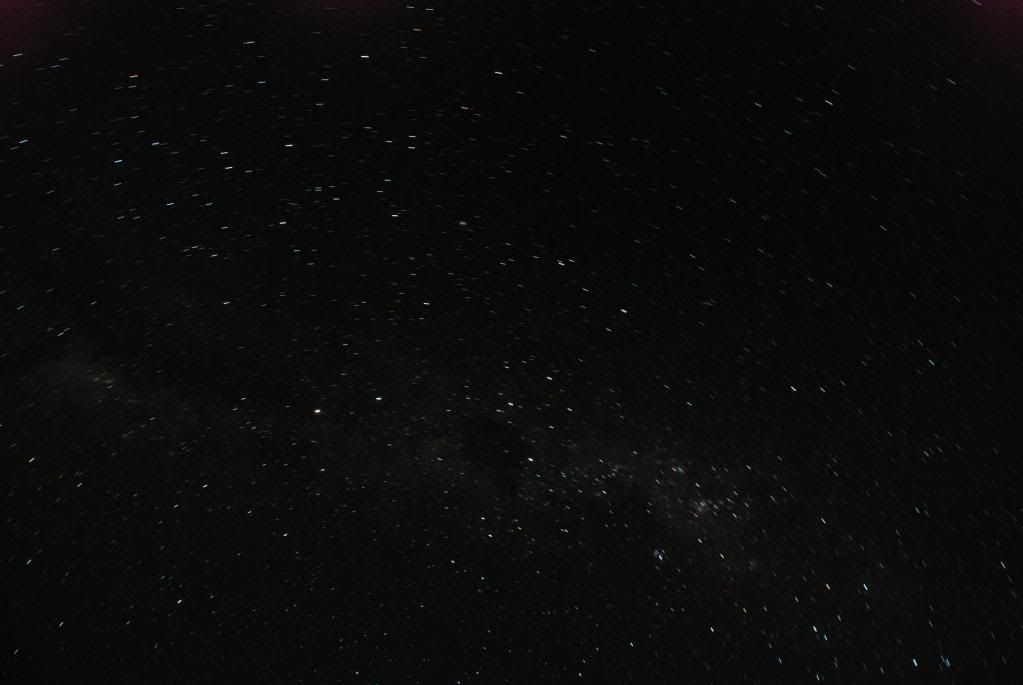
Gili Trewengan was the main reason I had come to Lombok. It is the westernmost of three small islands off Lombok's northwest side, and in the past few years has become associated with drunken backpacker hoards who spill over from Bali and want to drink and take easily available drugs. As you can imagine, that wasn't my priority.
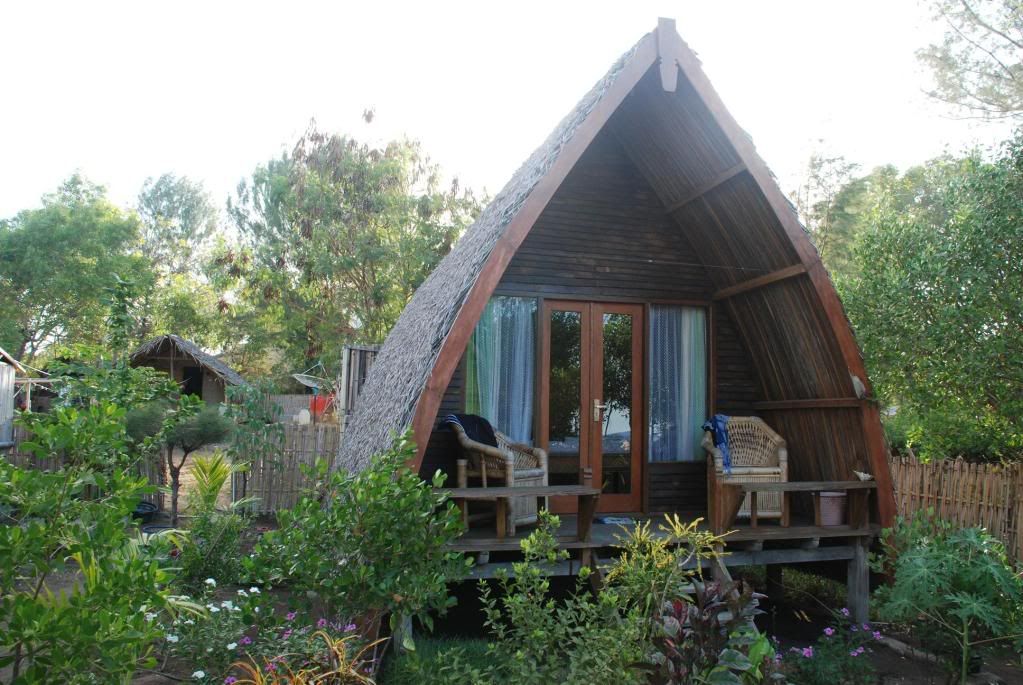
My Gili Trewengan bungalow...
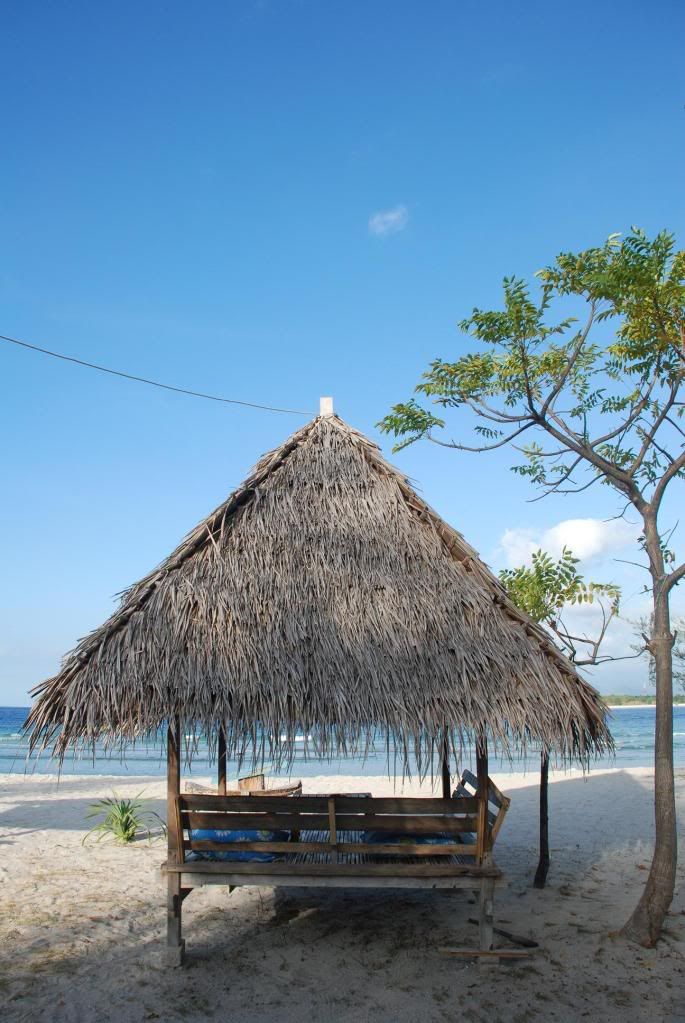
... and breakfast spot
Back in Pulau Weh, Sumatra, I had met Delphine, a dive instructor who was also a founder of the Gil Eco Trust. With the huge amount of scuba diving on the Gilis, the GET is currently pioneering work in reef rehabilitation with it's "BioRock" and attracts scientists from all over the world to it's workshops. The GET also gets involved with on-land issues affecting Gili Trewengan, and I had volunteered my services to spend a few days trying to neuter some of the island's huge and expanding cat population.
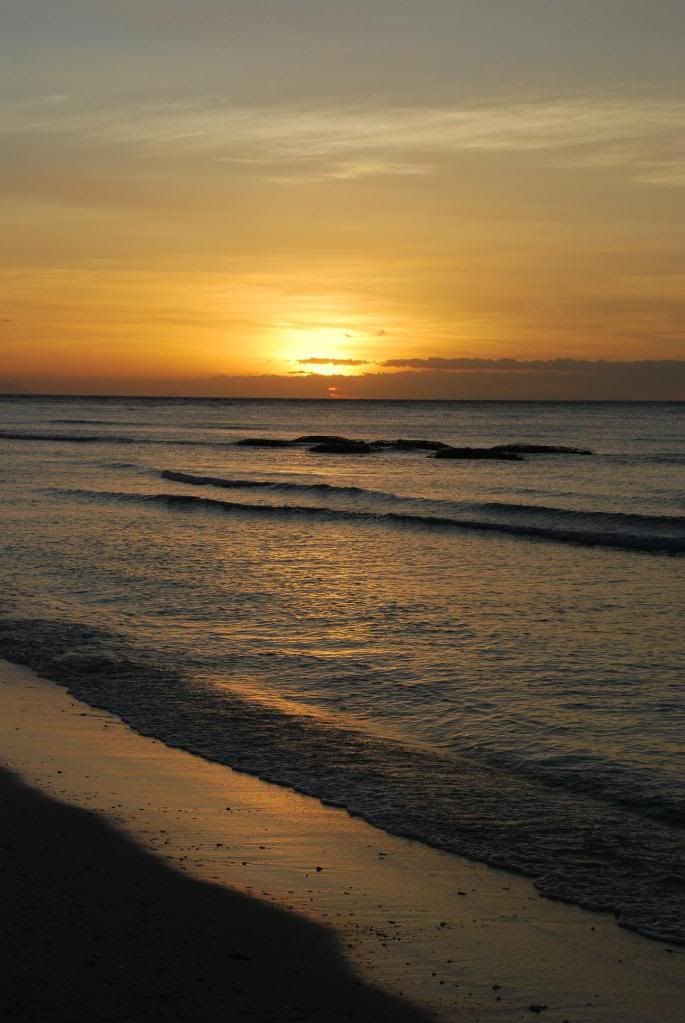
Sunset on Gili Trewengan, BioRock visible in the waves
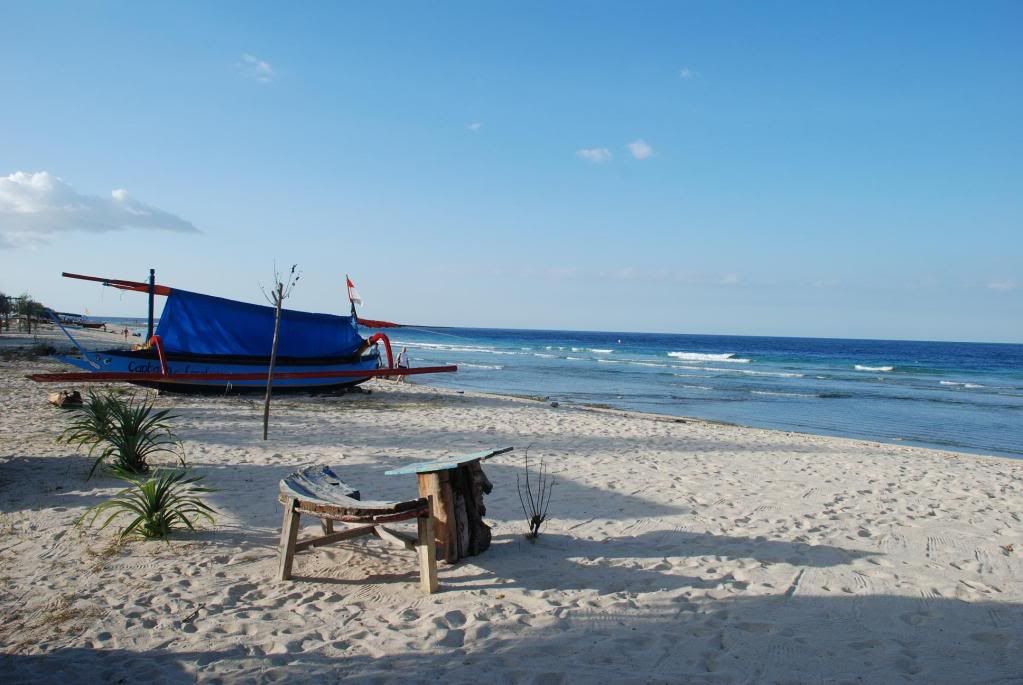
The plan was to invite over Pak Gede, a well recognised vet from Lombok, and to work together for a few days to spay and castrate as many cats as we could. As it turned out, I came a few days earlier than Pak Gede planned to, so found myself with a few spare days in which I did some diving and generally relaxed. On the boat from Senggigi I met Francis and Vicky, a couple of doctors who I got on well with and didn't seem to mind when I piggybacked their romantic holiday. After a couple of days diving, eating fabulous sea food, and publicizing the spay clinic, they headed back to Bali from where Francis was heading home.
On the 4th July Pak Gede arrived and we set up an impromptu clinic in the office of the Village Chief. The chief problem with this kind of work is finding and restraining the patients; there were no cat cages so old cement sacks were used to transport rather unwilling patients, then the main office was used as a communal holding area before cats were anaesthetised. Needless to say it was a pretty messy with a lot of stressed cats in a room together, and often painful for the vet trying to catch and knock them out.
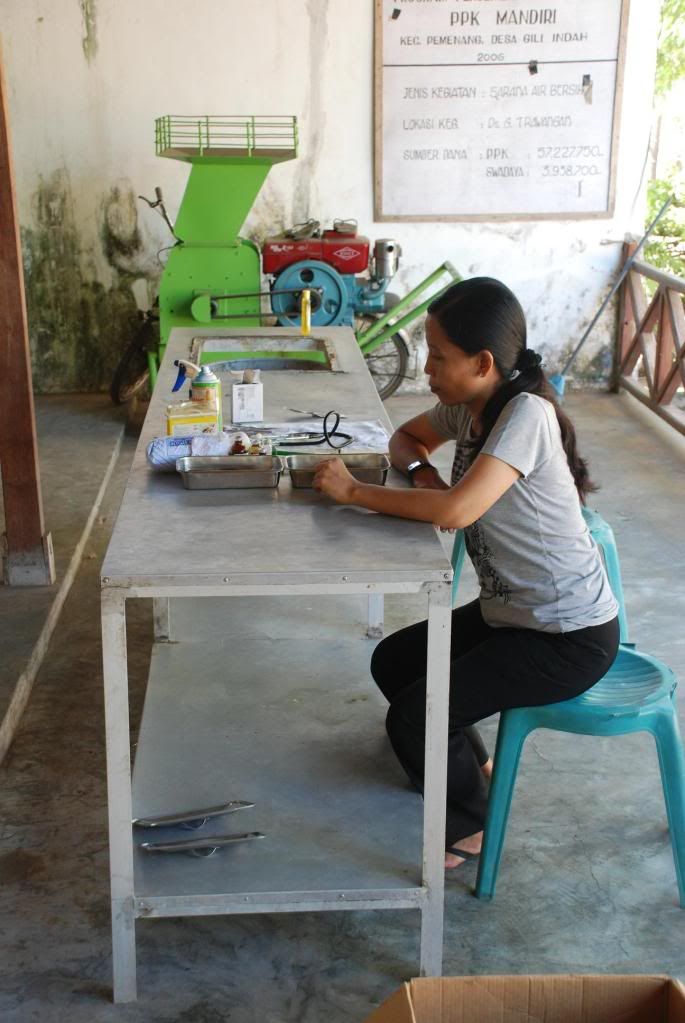
This is an operating theatre.....
I was able to introduce Pak Gede to the open castration technique and full ovariohysterectomy that are normally used in the UK, and we adapted the ketamine-only anaesthetic that he usually used (to good effect at his practice) when cats just wouldn't fall asleep.... He left that afternoon, leaving me with all his tools and a potentially lucrative few bottles of ketamine (there were people asking about it from a non-veterinary point of view). In all, we managed to neuter around 60 cats in a 4 day period, and were halted only when the presidential election took over the village office.
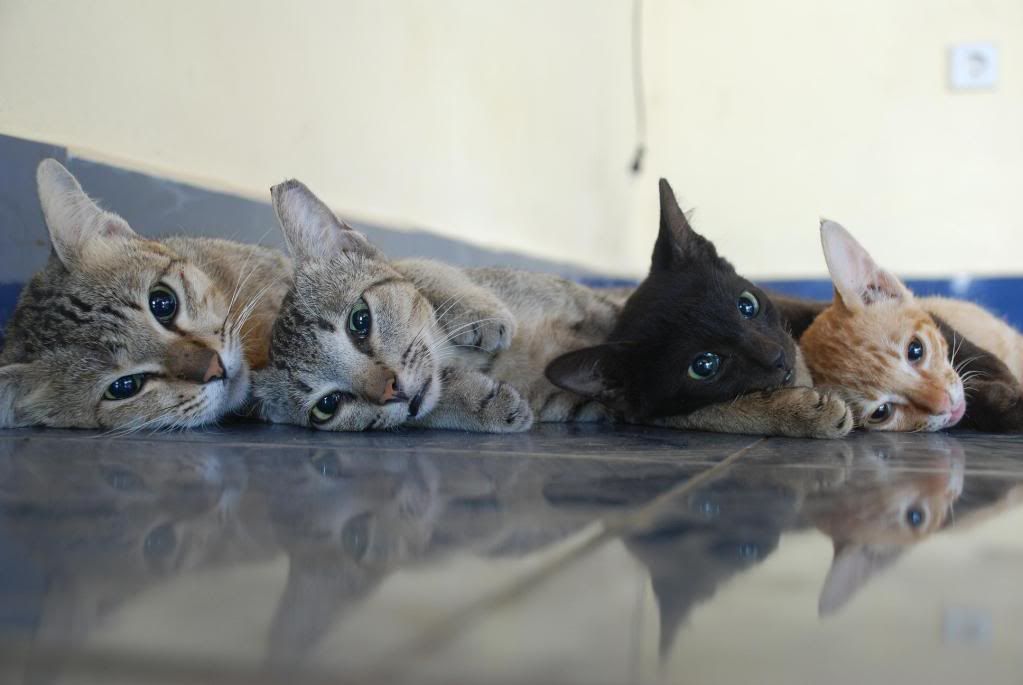
Patients sleeping it off
As a thank you from the Gili Eco Trust, I had three more days of diving with Delphine and the Big Bubble dive school where she worked - it was really good. In fact, much better than I had been led to believe. I met up with Malin and Wiggy, another couple of the Pulau Weh crew, and after being guided by Malin and with Wiggy as my dive buddy, we had dinner at Delphine's house..... it was great. I met up with Vicky again as well, who was booked to do a dive course and we found that our schedules matched pretty closely.
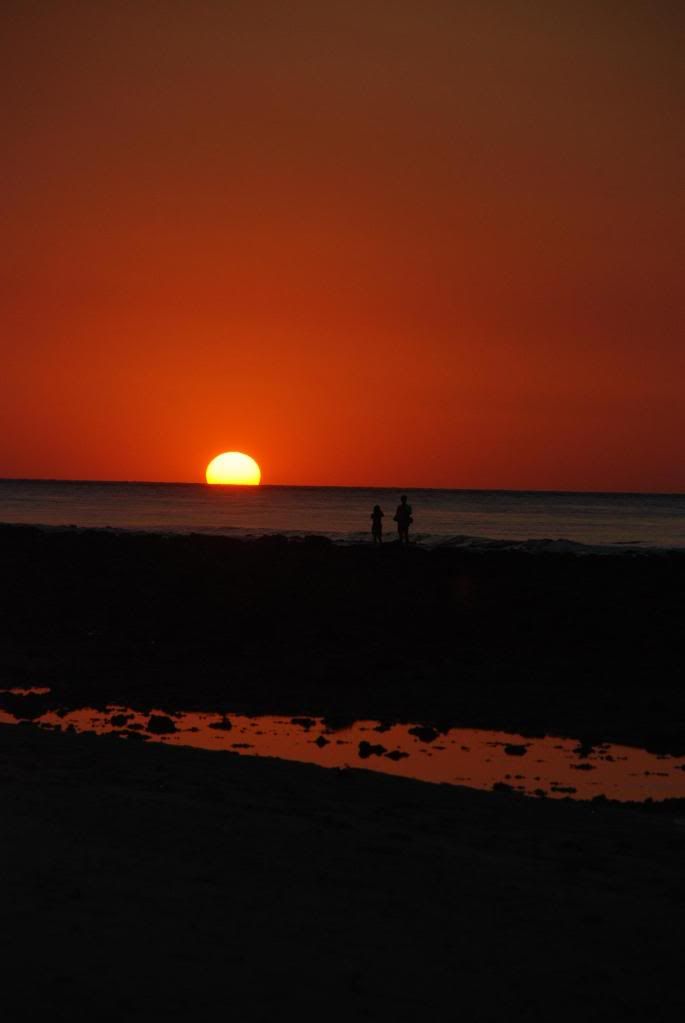
Gili sunset
I left Gili Trewengan after a couple of excellent weeks, with a much shorter than planned period to see a bit of Bali and Java before flying to Borneo. Vicky and I headed initially to Candi Dasa, a quiet seaside town in eastern Bali, which was a pretty good base form which to do the last dive we wanted, the Liberty wreck. The USAT Liberty was torpedoed in January 1942 just off Bali and then towed ashore, in order to salvage her cargo. It sat above the waterline for almost 20 years before the eruption of nearby Gunung Agung pushed her a short way offshore; in the past 40 years she has become one of the most accessible and safe large wreck dives in the world. We did a couple of excellent dives on the wreck, good for both the novelty and for the amount of coral that had grown since the ship was wrecked.
After a couple of days we headed up to Ubud, my other must-see stop on the island, and Bali's cultural centre. After the quiet of Candi Dasa it was a serious blow to the senses - never-ending offers of transport - and I mean never-ending. Even if you were in a car or on a bike, it would still be offered. The town has a proliferation of art galleries and restaurants, and in set on a wider scale amidst terraces of rice paddies that go on for miles. It is beautiful, but quite intense when coming from Gili Trewengan where there were no motor vehicles.
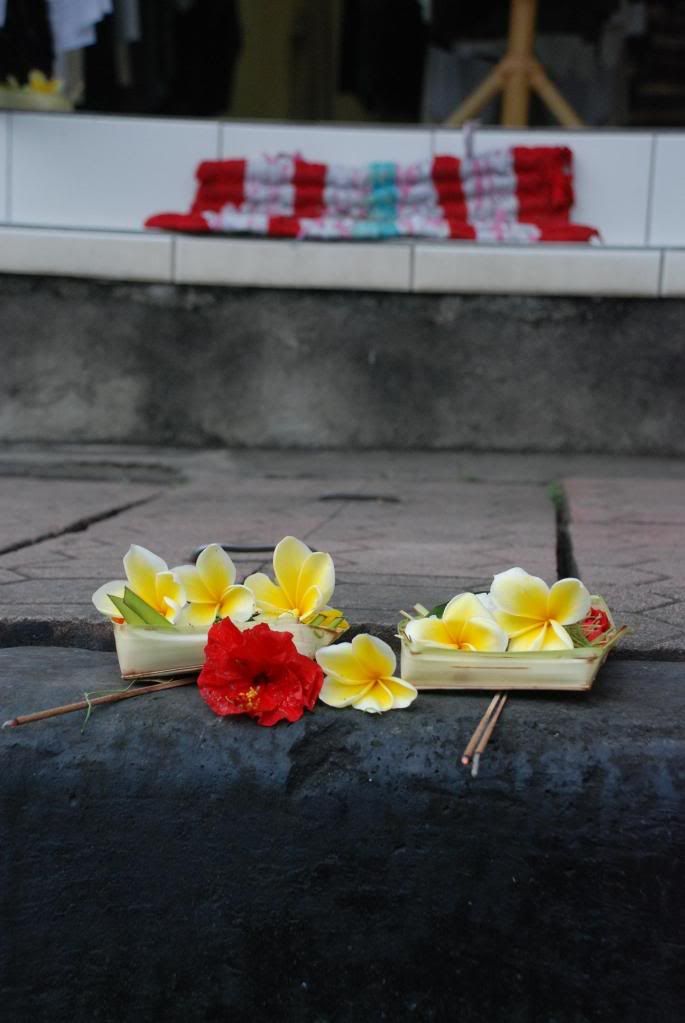
Ubud offerings
Bali is a predominantly Hindu island and has more holy sites than anywhere else in Indonesia, and outside of every shop was an offering and on every corner was a small temple. We saw the Sacred Monkey Forest - overrun with obese long tailed macaques feasting on tourist bananas and popcorn - and managed to avoid walking into either an art gallery, a traditional dance show, or in front of a motorbike ready to whisk us away.
The following morning - my last full day on Bali - we opted to try and get a feel for the area around Ubud. We started off on a walk outside of Ubud, through verdant rice paddies full of ducks and wiry men working in the knee deep water. Predictably we had a couple of people offer to be our guides which we kindly turned down. After a successful start, we found our way blocked by "No Trespassing" signs and a man clearly waiting to "guide" us past and along the route. He glibly expressed his surprise at the no entry signs and offered to help - we declined fairly impolitely and headed back to town. En route we say an impromptu pig abbatoir: pigs in huge woven baskets being drowned as a way of "stunning" them before slaughter - it was awful.
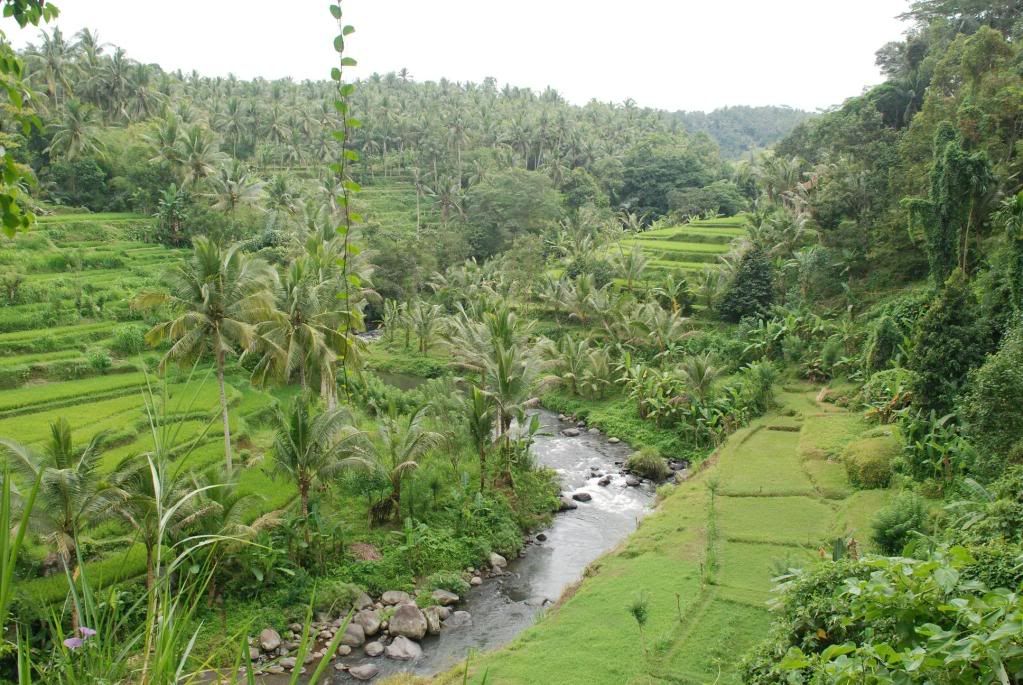
Rice paddies outside of Ubud
That afternoon I took mine (and Vicky's) life into my own hands and hired a motorbike to visit some outlying temples in the Ubud region. We made a quick tour of the famous Elephant Cave - not so exciting to me - and a bas-relief at Yeh Pulu, which was fantastic in it's position in the rice paddies, although a challenge to get to. We headed on, with Vicky terrified into silence by my driving (I thought it was great) over to Gunung Kawi, Bali's most impressive temple with a series of 10 huge statues carved into rock. Theories abound about their origin, but most agree it was something to do with a 9th century king and his many, many wives.
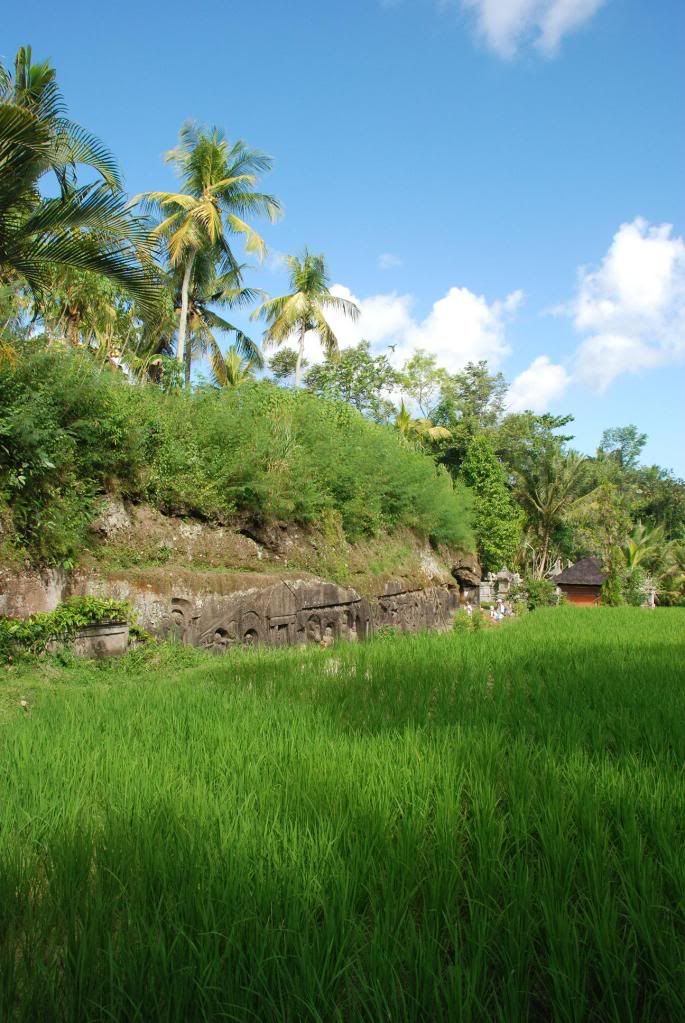
Yeh Pulu
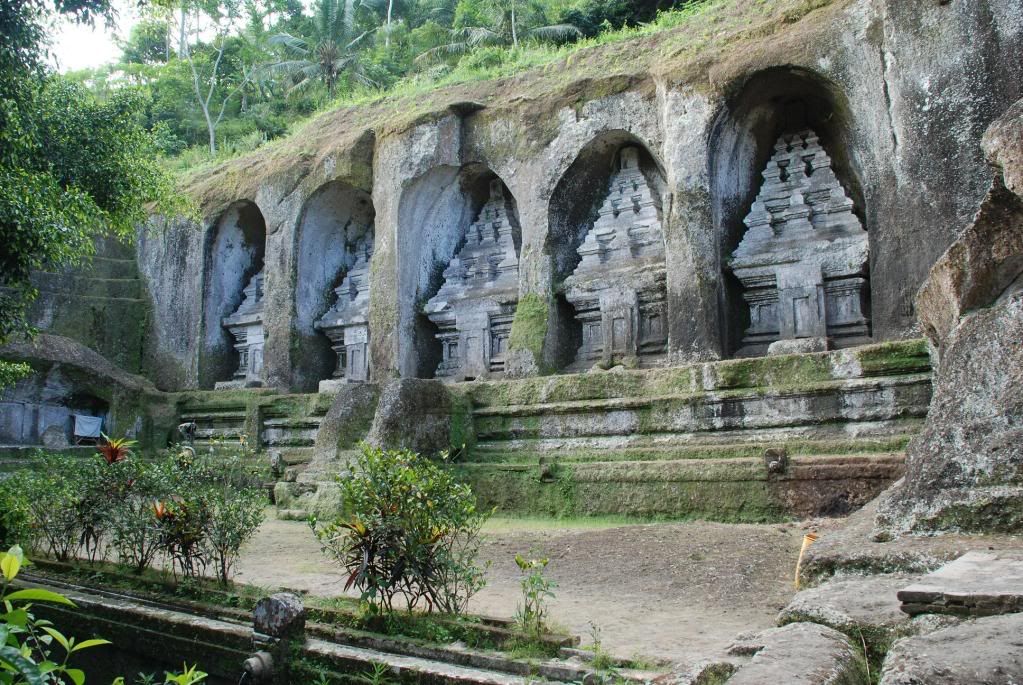
Gunung Kawi
The following day my westward path continued - I went with Vicky to the airport and as she flew home, I caught a flight to Surabaya in Java. It was quick and cheap, and Surabaya was surprisingly friendly and helpful as I then headed over to that day's destination - Mount Bromo.
Mount Bromo is possibly Java's finest volcano, although not it's tallest or biggest. It has a 10km wide crater, inside of which two smaller volcanos reside, the active one being Bromo. It is a must-visit on the tourist trail, although there were precious few as I came by public transport from Surabaya to Cemoro Lawang, a village on the crater rim. I settled in a cheap guesthouse with freezing cold waer and flea-ridden blankets, and admired the view.
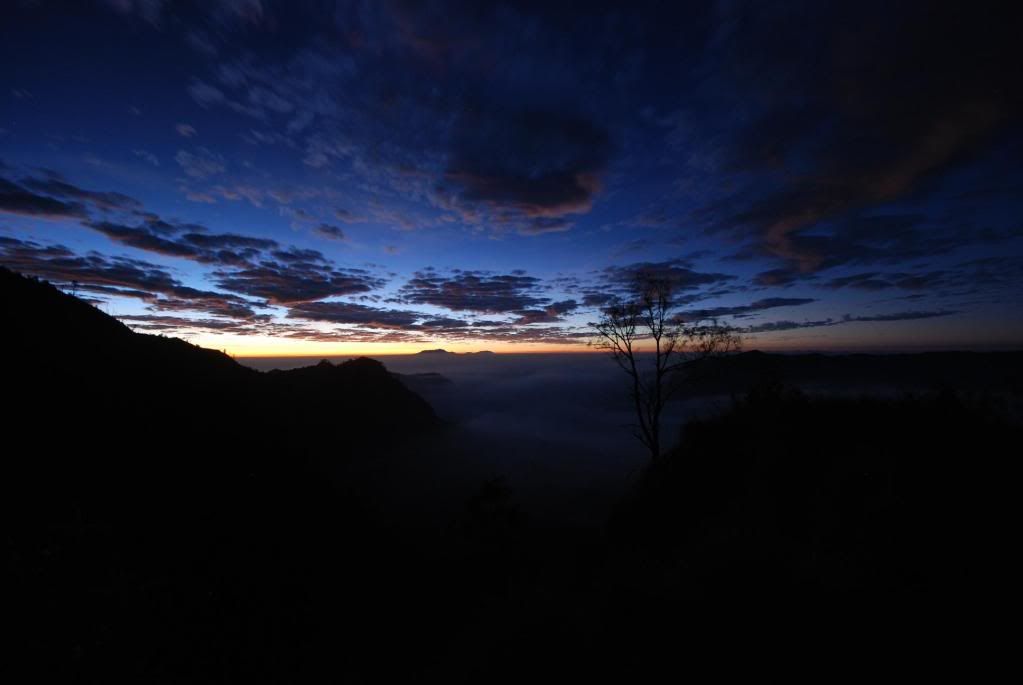
Most tourists who visit Bromo do so as a package from Yogyakarta, a city some 10 hours distant, and arrive late, sleep briefly in a guesthouse then roar up to a viewpoint in a 4x4 for sunrise before heading back to Yogya. The alternative - not all that different - is to visit enroute to or from Bali to Yogya, pretty much as I was doing. A small number of people each day (myself included) opted to take the 2 hour climb up to the viewpoint for sunrise, so just after 3am I was out in the moonlight, revelling in the cool air but choking on the intermittent noxious volcanic fumes.
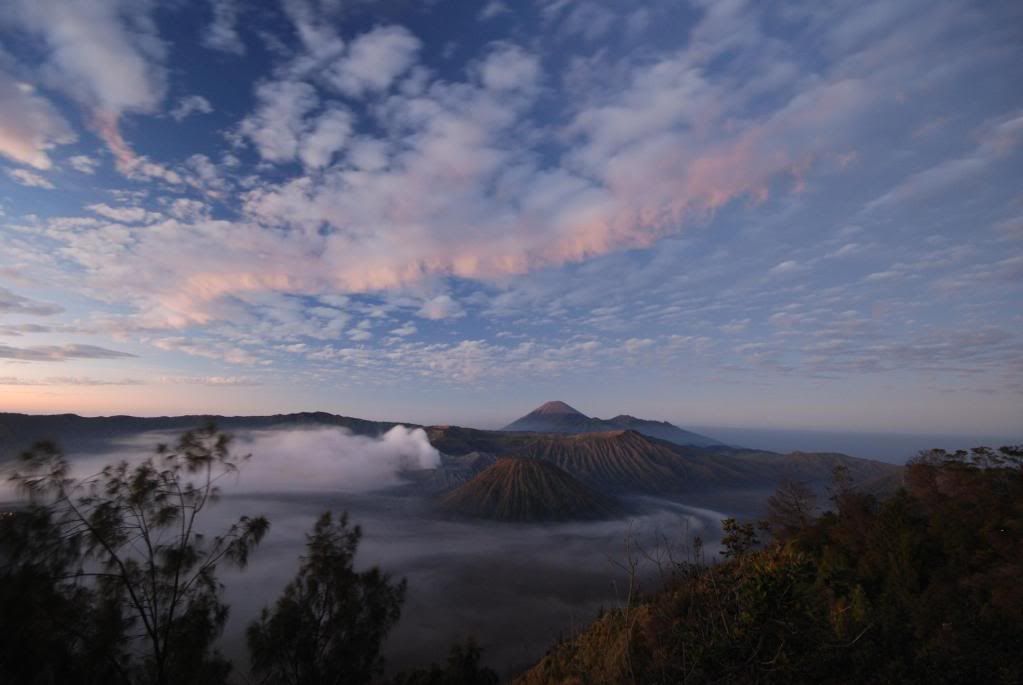
I reached the viewpoint summit quicker than expected and left almost as quickly - by that point some 50 or 60 jeeps had deposited their loads of tourists and the place was heaving. I headed back down 20 minutes to an alternative viewpoint that I shared with a few other walkers, and enjoyed a spectacuar sunrise.
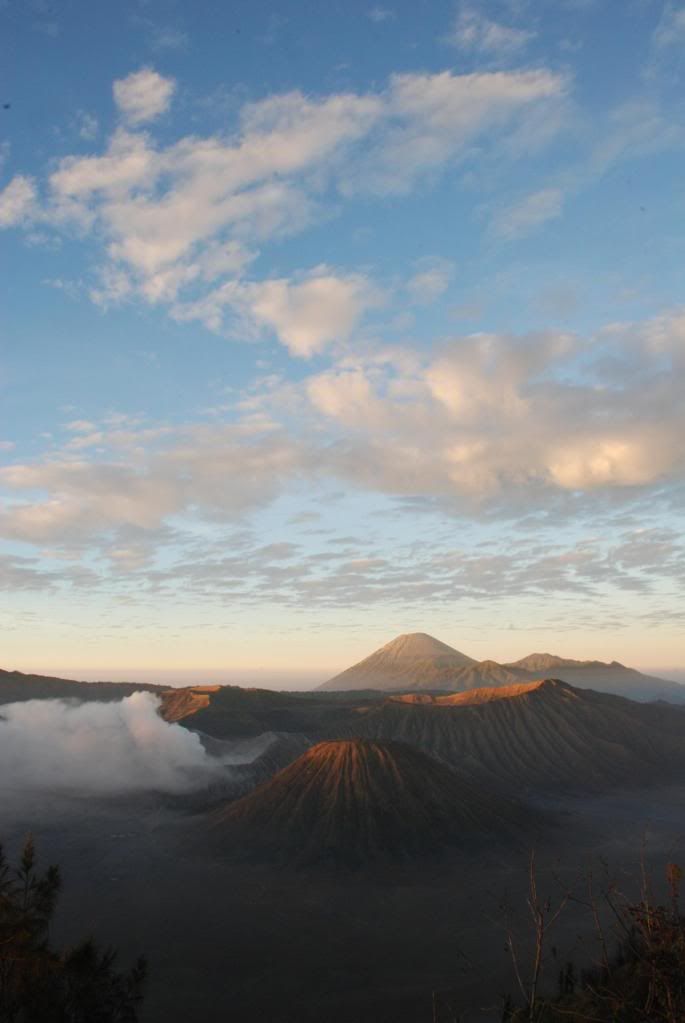
After descending back to Cemoro Lawang I managed to find my way onto a luxurious shuttle that took the rest fo the day to reach my last proper destination in Java, Yogyakarta. Yogya is to Java what Ubud is to Bali - it's cultural capital. Nearby, the huge Buddihst temple of Borobodur and Hindu temple of Prambenan are World Heritage Sites, and the city supports a huge number of artists producing batik art of varying quality (most of it is pure tat). Fortunately, with the amount of time I had, I opted to avoid the batik salesman - always instant best friends happy to show you around for free, as long as you visit their gallery. Instead as soon as I arrived at night, I booked yet another sunrise tour or the nearby temples for my only full day in Yogya.
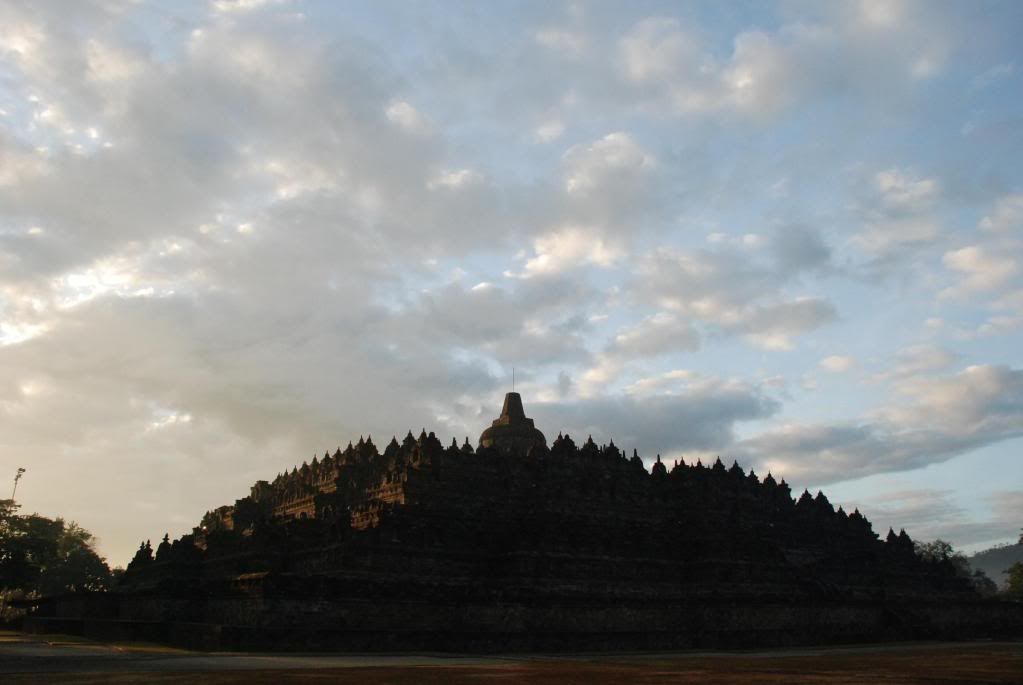
Borobodur at sunrise
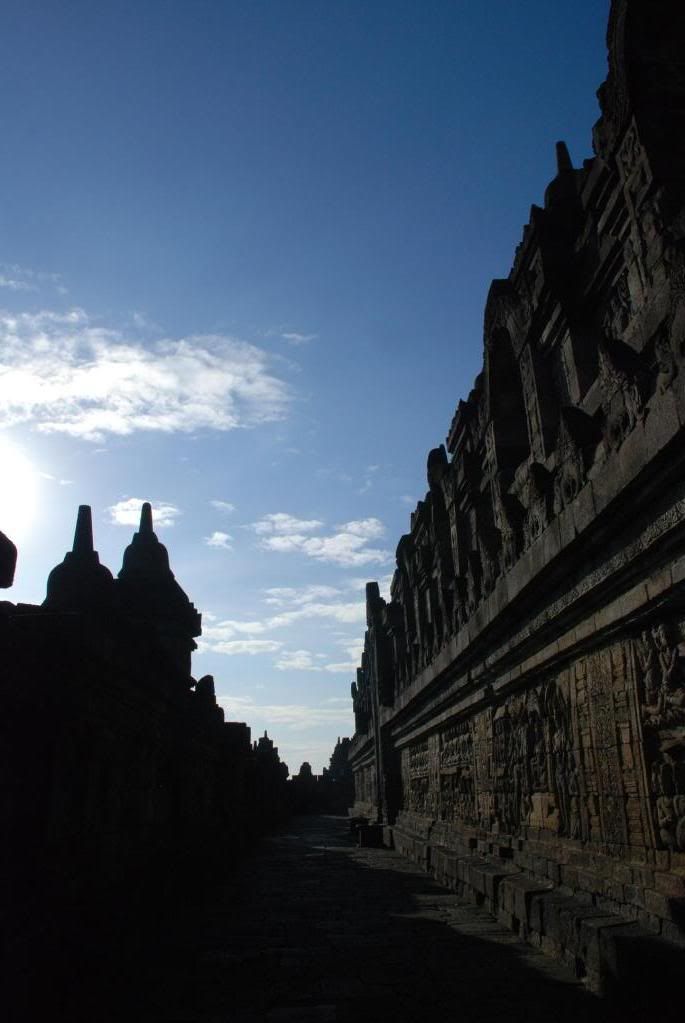
At 6am the gates of Borobodur swung open; I skipped my "Free Welcome Drink for VIPs" and headed straight over to the temple. Built sometime around the 9th century and almost at the same time as neighbouring Prambenan, Borobodur is deservedly the finest Buddhist monument in Java. It has a series of 6 square terraces covered in reliefs, then a group of central stupas on top surround the central huge stupa respresenting Mount Meru. The reliefs show images of everything from normal everyday life to stories and legends.
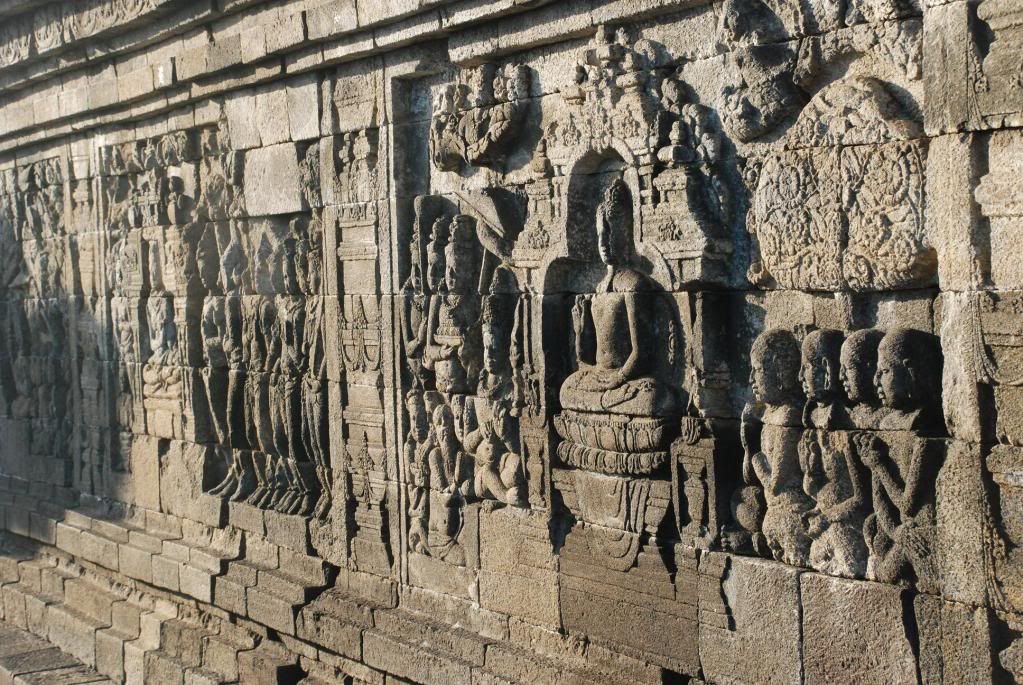
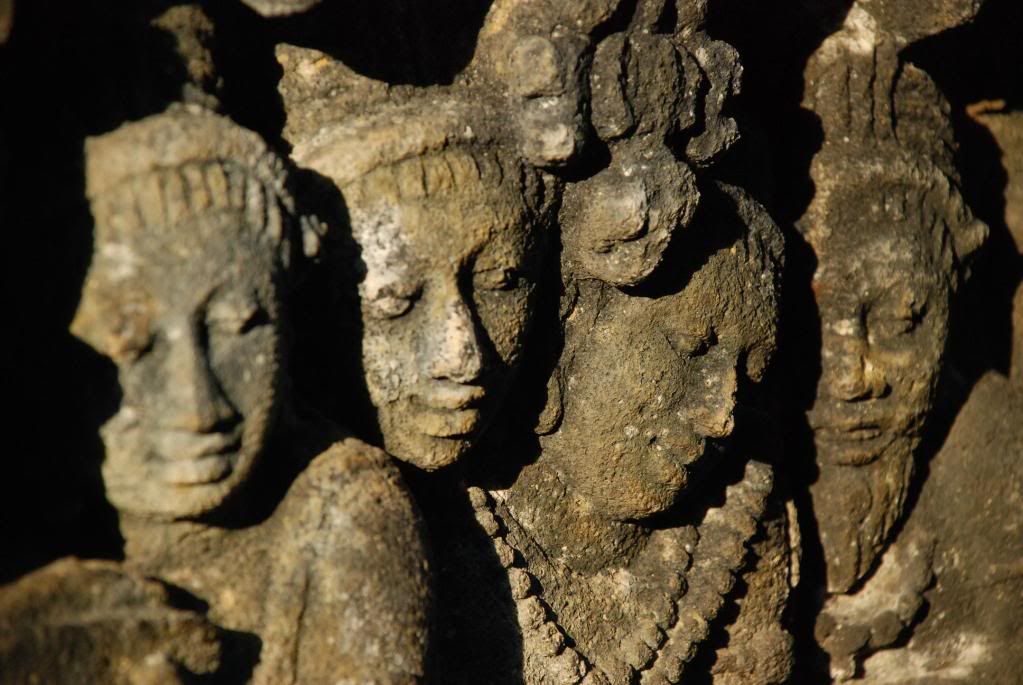
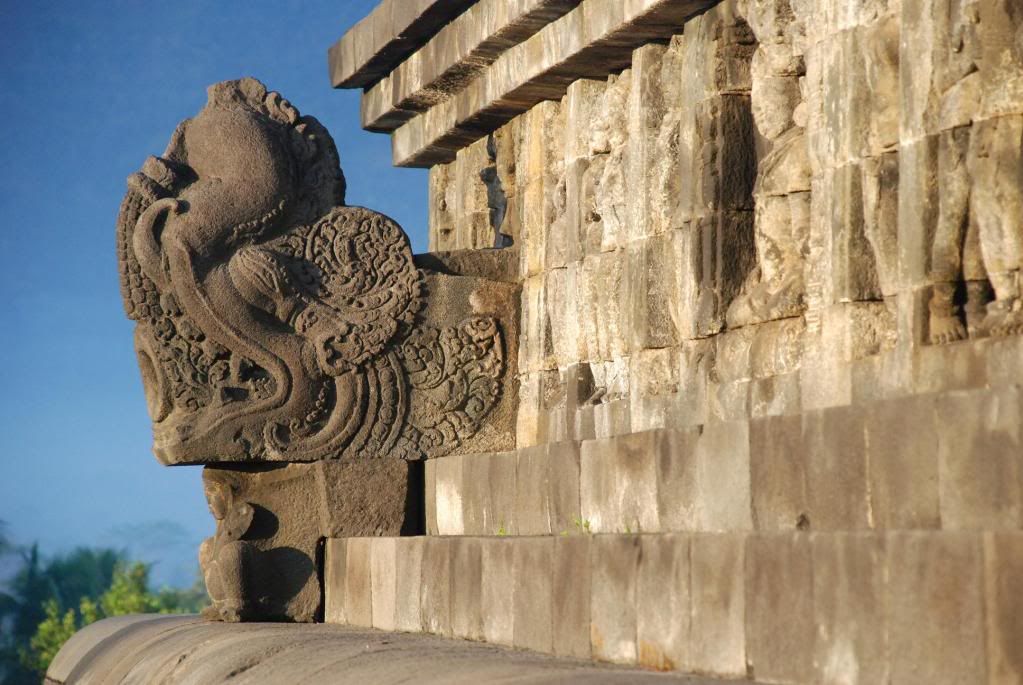
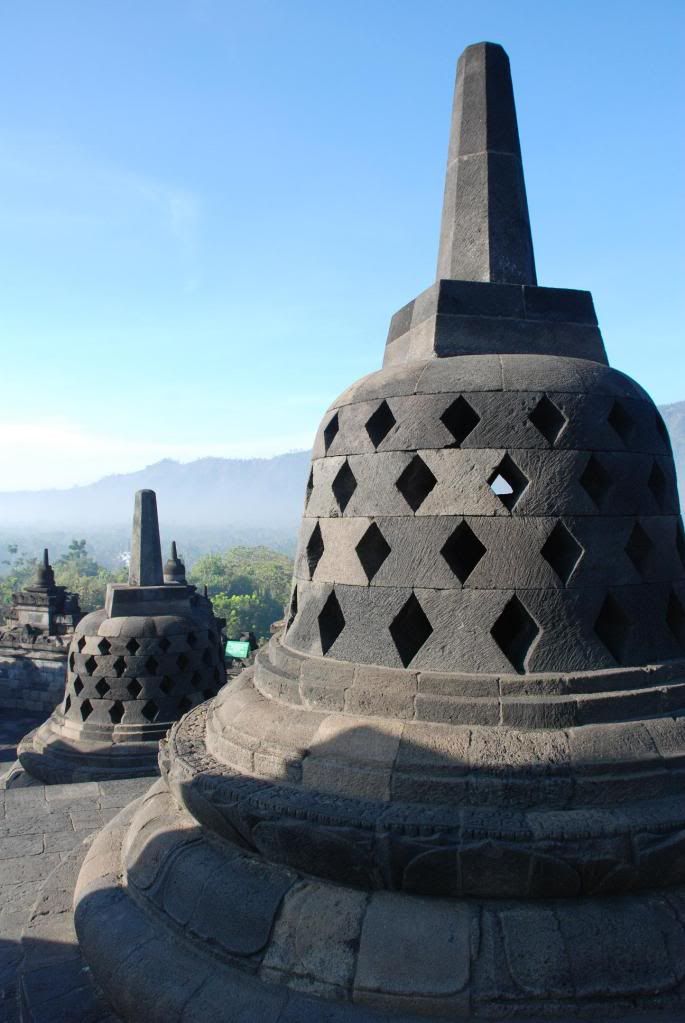
I kept with protocol and circled the temple clockwise at each level, admiring the reliefs and the light as the sun rose. It was very impressive and surprisingly quiet given the numbers of tourists who had been waiting at th gate. After two hours I had made it to the top and back down again, ready for breakfast and Prambenan.
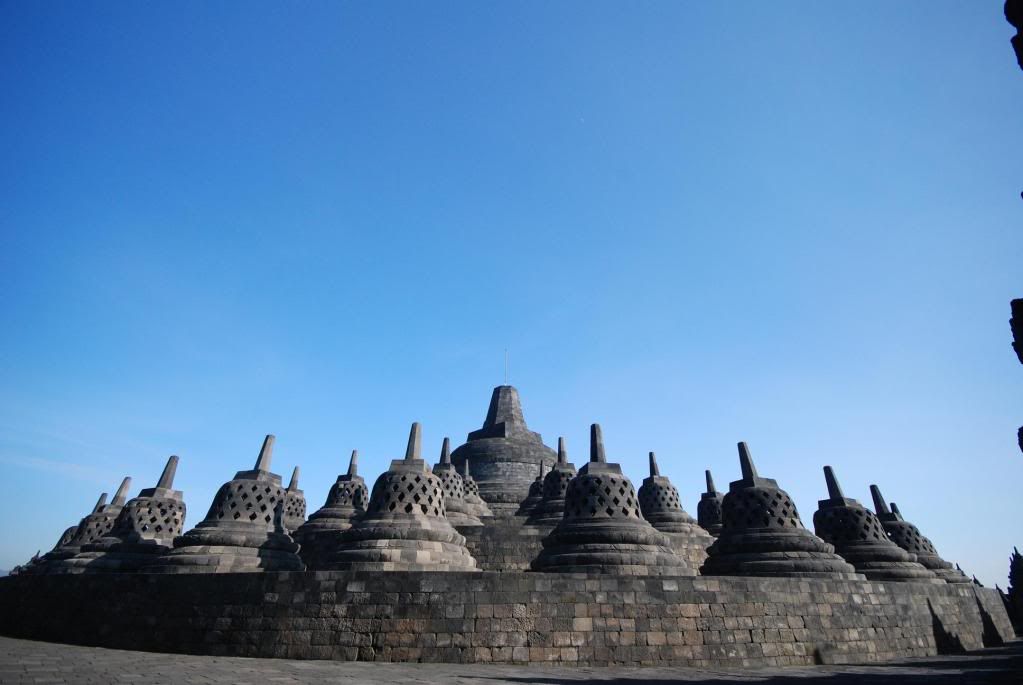
Prambenan is actually a series of temples dedicated to both Hindu gods and Buddhism. All the temples were damaged by a 5.8 richter scale earthquake in 2005 and many of the monuments are still undergoing extensive repairs, and are shrouded in red scaffolding and bamboo props. It was not as impressive as Borobodur, but in it's heyday - and undamaged - it would have been amazing.
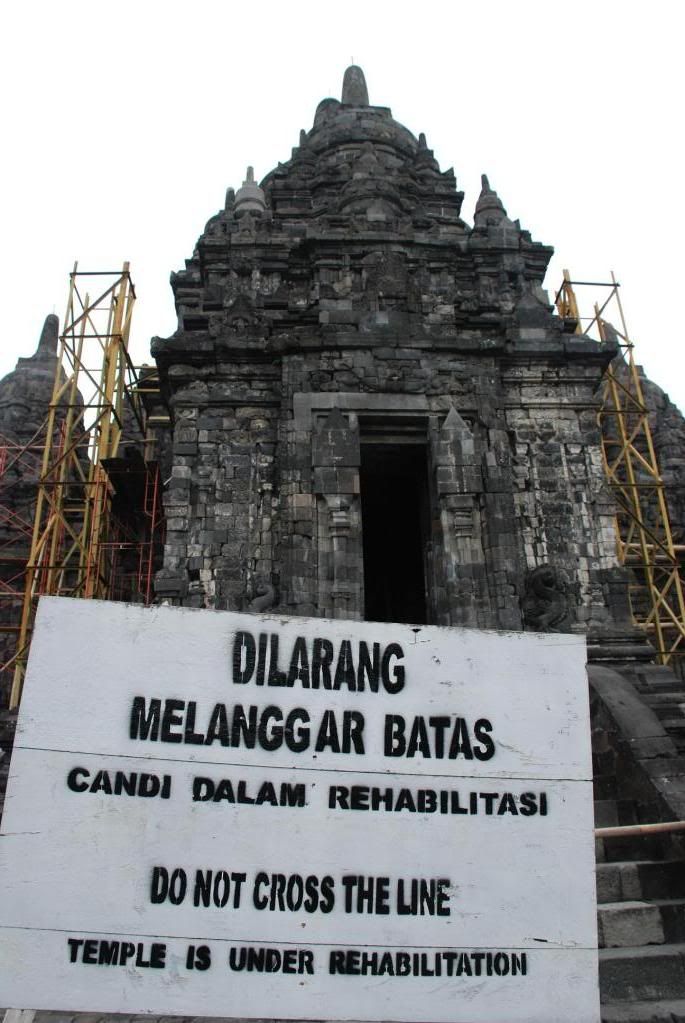
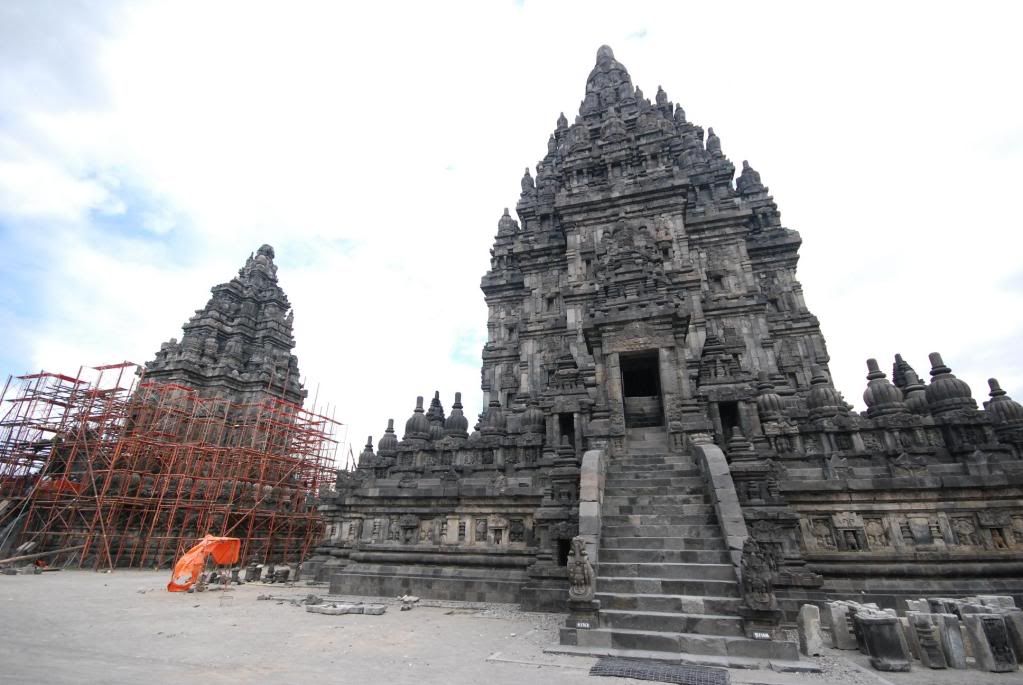
That afternoon I was back in Yogya and on a quick walking tour of the city. The centre of the city is the Kraton, the palace of the Sultan who still governs the Yogya.... it was closed. Instead I visited the old Taman Sari or water palace, undergoing renovations after the earthquake and overpopulated with batik salesmen. I had a wander around the bird market too - famous not only for it's songbords and fighting cocks, but also for the pets you can buy there - snakes, geckos, monkeys, owls, squirrels. It was grim, not least because you still feel an obligation to smile at the stall owners touting their wares. I stopped by the old Dutch fort in the centre and almost fell over when the guards told me not to worry about paying the admission charge - that was a turn up for the books. But by then it was getting late, tourists were looking for places to eat and I wasn't staying long.
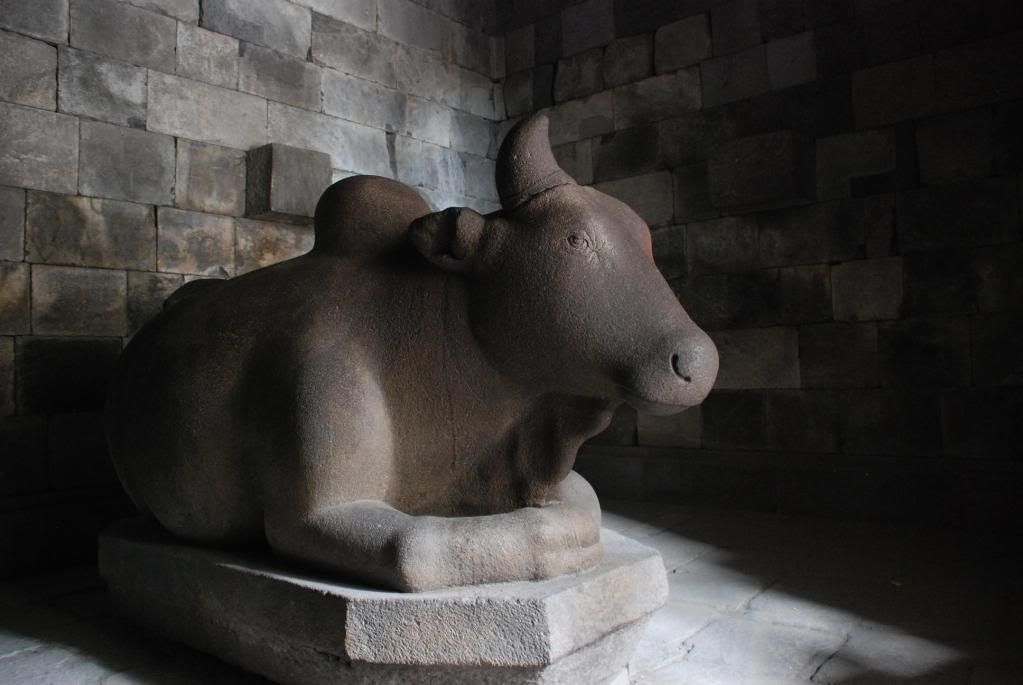
Vishnu ( I think) inside his temple at Prambenan
Fate has a way of interfering in your plans - originally I had hoped to spend several weeks crossing Bali and Java before flying up to Kuching in Sarawak, Malaysian Borneo. That would have put me in Jakarta yesterday (although certainly not at any 5 star hotels). Instead I fly from Yogya this morning and end up in Borneo tonight.

Monkey in a bin.... Rinjani
After a dinner with Francisco and Michela from the boat - we were to meet again in a few days - I turned in early for my early start the next day. After a very windy 2 hour car journey, by 7.30am I was on the trail with Sean and Justina, a nice American couple, plus our superhuman guides and porters who were happily walking up in flip flops with huge loads on bamboo poles over their shoulders.
Within a couple of hours it was very, very warm and we were all drenched in sweat. The climb went on, ever uphill - the total height gain was some 2000m. There was an early lunch at 11.30am before we reached the crater rim in quick time - by about 2.30pm. Then it was a case of relaxing, watching, and trying not to get cold. Since the volcano increased its activity a few months ago and the lake and summit were closed, rangers have camped out at the crater rim to stop tourists venturing too far. We had met some climbing up, and they were very friendly despite being armed with machine guns to deter those really persistent travelers.

Gunung Baru, the small active central volcano, sounded almost like waves breaking as it gave out regular belches of steam and, as we were to see later, rocks and ash. As the afternoon pressed on the clouds cleared and we were treated to a stunning view over the whole crater, although below us the rest of Lombok was covered in cloud.

As the sun set the night grew colder but the views got better. Overhead was a cloudless, starry sky, whilst in the crater the glowing lava of Gunung Baru was an impressive sight. We turned in early again to the small forest of tents perched on the crater rim, tired and cold but full of excellent nasi goreng (fried rice) and plentiful tea.


Sunset from Rinjani - Gunung Agung volcano, Bali, in the background


The following morning I was up for a disappointing sunrise - mostly obscured by the peak of Rinjani and the gases form the volcano - and we headed off back down the mountain after breakfast. In a moment of supreme fallacy I decided to try and race our guide down the steepest, slipperiest part of the volcano - it felt good at the time but I regretted it for about the next 4 days to come. Back in Senggigi a few hours later I had time for some laundry, more offers of transport and some rest, before I headed over to Gili Trewengan the next day.

Gili Trewengan was the main reason I had come to Lombok. It is the westernmost of three small islands off Lombok's northwest side, and in the past few years has become associated with drunken backpacker hoards who spill over from Bali and want to drink and take easily available drugs. As you can imagine, that wasn't my priority.

My Gili Trewengan bungalow...

... and breakfast spot
Back in Pulau Weh, Sumatra, I had met Delphine, a dive instructor who was also a founder of the Gil Eco Trust. With the huge amount of scuba diving on the Gilis, the GET is currently pioneering work in reef rehabilitation with it's "BioRock" and attracts scientists from all over the world to it's workshops. The GET also gets involved with on-land issues affecting Gili Trewengan, and I had volunteered my services to spend a few days trying to neuter some of the island's huge and expanding cat population.

Sunset on Gili Trewengan, BioRock visible in the waves

The plan was to invite over Pak Gede, a well recognised vet from Lombok, and to work together for a few days to spay and castrate as many cats as we could. As it turned out, I came a few days earlier than Pak Gede planned to, so found myself with a few spare days in which I did some diving and generally relaxed. On the boat from Senggigi I met Francis and Vicky, a couple of doctors who I got on well with and didn't seem to mind when I piggybacked their romantic holiday. After a couple of days diving, eating fabulous sea food, and publicizing the spay clinic, they headed back to Bali from where Francis was heading home.
On the 4th July Pak Gede arrived and we set up an impromptu clinic in the office of the Village Chief. The chief problem with this kind of work is finding and restraining the patients; there were no cat cages so old cement sacks were used to transport rather unwilling patients, then the main office was used as a communal holding area before cats were anaesthetised. Needless to say it was a pretty messy with a lot of stressed cats in a room together, and often painful for the vet trying to catch and knock them out.

This is an operating theatre.....
I was able to introduce Pak Gede to the open castration technique and full ovariohysterectomy that are normally used in the UK, and we adapted the ketamine-only anaesthetic that he usually used (to good effect at his practice) when cats just wouldn't fall asleep.... He left that afternoon, leaving me with all his tools and a potentially lucrative few bottles of ketamine (there were people asking about it from a non-veterinary point of view). In all, we managed to neuter around 60 cats in a 4 day period, and were halted only when the presidential election took over the village office.

Patients sleeping it off
As a thank you from the Gili Eco Trust, I had three more days of diving with Delphine and the Big Bubble dive school where she worked - it was really good. In fact, much better than I had been led to believe. I met up with Malin and Wiggy, another couple of the Pulau Weh crew, and after being guided by Malin and with Wiggy as my dive buddy, we had dinner at Delphine's house..... it was great. I met up with Vicky again as well, who was booked to do a dive course and we found that our schedules matched pretty closely.

Gili sunset
I left Gili Trewengan after a couple of excellent weeks, with a much shorter than planned period to see a bit of Bali and Java before flying to Borneo. Vicky and I headed initially to Candi Dasa, a quiet seaside town in eastern Bali, which was a pretty good base form which to do the last dive we wanted, the Liberty wreck. The USAT Liberty was torpedoed in January 1942 just off Bali and then towed ashore, in order to salvage her cargo. It sat above the waterline for almost 20 years before the eruption of nearby Gunung Agung pushed her a short way offshore; in the past 40 years she has become one of the most accessible and safe large wreck dives in the world. We did a couple of excellent dives on the wreck, good for both the novelty and for the amount of coral that had grown since the ship was wrecked.
After a couple of days we headed up to Ubud, my other must-see stop on the island, and Bali's cultural centre. After the quiet of Candi Dasa it was a serious blow to the senses - never-ending offers of transport - and I mean never-ending. Even if you were in a car or on a bike, it would still be offered. The town has a proliferation of art galleries and restaurants, and in set on a wider scale amidst terraces of rice paddies that go on for miles. It is beautiful, but quite intense when coming from Gili Trewengan where there were no motor vehicles.

Ubud offerings
Bali is a predominantly Hindu island and has more holy sites than anywhere else in Indonesia, and outside of every shop was an offering and on every corner was a small temple. We saw the Sacred Monkey Forest - overrun with obese long tailed macaques feasting on tourist bananas and popcorn - and managed to avoid walking into either an art gallery, a traditional dance show, or in front of a motorbike ready to whisk us away.
The following morning - my last full day on Bali - we opted to try and get a feel for the area around Ubud. We started off on a walk outside of Ubud, through verdant rice paddies full of ducks and wiry men working in the knee deep water. Predictably we had a couple of people offer to be our guides which we kindly turned down. After a successful start, we found our way blocked by "No Trespassing" signs and a man clearly waiting to "guide" us past and along the route. He glibly expressed his surprise at the no entry signs and offered to help - we declined fairly impolitely and headed back to town. En route we say an impromptu pig abbatoir: pigs in huge woven baskets being drowned as a way of "stunning" them before slaughter - it was awful.

Rice paddies outside of Ubud
That afternoon I took mine (and Vicky's) life into my own hands and hired a motorbike to visit some outlying temples in the Ubud region. We made a quick tour of the famous Elephant Cave - not so exciting to me - and a bas-relief at Yeh Pulu, which was fantastic in it's position in the rice paddies, although a challenge to get to. We headed on, with Vicky terrified into silence by my driving (I thought it was great) over to Gunung Kawi, Bali's most impressive temple with a series of 10 huge statues carved into rock. Theories abound about their origin, but most agree it was something to do with a 9th century king and his many, many wives.

Yeh Pulu

Gunung Kawi
The following day my westward path continued - I went with Vicky to the airport and as she flew home, I caught a flight to Surabaya in Java. It was quick and cheap, and Surabaya was surprisingly friendly and helpful as I then headed over to that day's destination - Mount Bromo.
Mount Bromo is possibly Java's finest volcano, although not it's tallest or biggest. It has a 10km wide crater, inside of which two smaller volcanos reside, the active one being Bromo. It is a must-visit on the tourist trail, although there were precious few as I came by public transport from Surabaya to Cemoro Lawang, a village on the crater rim. I settled in a cheap guesthouse with freezing cold waer and flea-ridden blankets, and admired the view.

Most tourists who visit Bromo do so as a package from Yogyakarta, a city some 10 hours distant, and arrive late, sleep briefly in a guesthouse then roar up to a viewpoint in a 4x4 for sunrise before heading back to Yogya. The alternative - not all that different - is to visit enroute to or from Bali to Yogya, pretty much as I was doing. A small number of people each day (myself included) opted to take the 2 hour climb up to the viewpoint for sunrise, so just after 3am I was out in the moonlight, revelling in the cool air but choking on the intermittent noxious volcanic fumes.

I reached the viewpoint summit quicker than expected and left almost as quickly - by that point some 50 or 60 jeeps had deposited their loads of tourists and the place was heaving. I headed back down 20 minutes to an alternative viewpoint that I shared with a few other walkers, and enjoyed a spectacuar sunrise.

After descending back to Cemoro Lawang I managed to find my way onto a luxurious shuttle that took the rest fo the day to reach my last proper destination in Java, Yogyakarta. Yogya is to Java what Ubud is to Bali - it's cultural capital. Nearby, the huge Buddihst temple of Borobodur and Hindu temple of Prambenan are World Heritage Sites, and the city supports a huge number of artists producing batik art of varying quality (most of it is pure tat). Fortunately, with the amount of time I had, I opted to avoid the batik salesman - always instant best friends happy to show you around for free, as long as you visit their gallery. Instead as soon as I arrived at night, I booked yet another sunrise tour or the nearby temples for my only full day in Yogya.

Borobodur at sunrise
At 6am the gates of Borobodur swung open; I skipped my "Free Welcome Drink for VIPs" and headed straight over to the temple. Built sometime around the 9th century and almost at the same time as neighbouring Prambenan, Borobodur is deservedly the finest Buddhist monument in Java. It has a series of 6 square terraces covered in reliefs, then a group of central stupas on top surround the central huge stupa respresenting Mount Meru. The reliefs show images of everything from normal everyday life to stories and legends.


I kept with protocol and circled the temple clockwise at each level, admiring the reliefs and the light as the sun rose. It was very impressive and surprisingly quiet given the numbers of tourists who had been waiting at th gate. After two hours I had made it to the top and back down again, ready for breakfast and Prambenan.

Prambenan is actually a series of temples dedicated to both Hindu gods and Buddhism. All the temples were damaged by a 5.8 richter scale earthquake in 2005 and many of the monuments are still undergoing extensive repairs, and are shrouded in red scaffolding and bamboo props. It was not as impressive as Borobodur, but in it's heyday - and undamaged - it would have been amazing.


That afternoon I was back in Yogya and on a quick walking tour of the city. The centre of the city is the Kraton, the palace of the Sultan who still governs the Yogya.... it was closed. Instead I visited the old Taman Sari or water palace, undergoing renovations after the earthquake and overpopulated with batik salesmen. I had a wander around the bird market too - famous not only for it's songbords and fighting cocks, but also for the pets you can buy there - snakes, geckos, monkeys, owls, squirrels. It was grim, not least because you still feel an obligation to smile at the stall owners touting their wares. I stopped by the old Dutch fort in the centre and almost fell over when the guards told me not to worry about paying the admission charge - that was a turn up for the books. But by then it was getting late, tourists were looking for places to eat and I wasn't staying long.

Vishnu ( I think) inside his temple at Prambenan
Fate has a way of interfering in your plans - originally I had hoped to spend several weeks crossing Bali and Java before flying up to Kuching in Sarawak, Malaysian Borneo. That would have put me in Jakarta yesterday (although certainly not at any 5 star hotels). Instead I fly from Yogya this morning and end up in Borneo tonight.


